Last Updated: September 2026
Ask about toothpaste brands of India and you will get a list of names. What you rarely get is the thing that actually helps you shop: which company stands behind each name, which of them are Indian-owned and which are Indian-marketed subsidiaries of global groups, and what each brand is genuinely good at as opposed to what it advertises. This guide answers all three.
The ownership question matters more than it sounds. It explains why several famous brands sell a different formula in India than they do abroad, why the ayurvedic names cluster under only three or four parent companies, and why a shelf that looks like fifteen competing brands is really four or five corporate groups arguing with each other. Once you see the map, the shelf stops being confusing.
The competence question matters even more. Every brand claims everything, but in practice each one has an area where it is genuinely the strongest option and several where it is simply present. Dabur is unmatched in the ayurvedic segment. Haleon owns sensitivity and gum care with actives nobody else in India offers. Colgate dominates plain cavity protection on scale and cost. Knowing which brand is good at which job is how you stop buying by advertisement.
Everything below draws on the Indian product listings rather than international ones, because in this category the difference is real and repeatedly consequential. Two of the most recognised toothpaste brands in India sell formulations here that differ meaningfully from the versions foreign reviewers describe, and in one of those cases the Indian version is the better product.
Quick Comparison
| Product | Best For | Rating | Link |
|---|---|---|---|
| Colgate Strong Teeth Calcium Boost | Colgate: scale, cost and cavity protection | 4.4 (42,100) | Check Price |
| Dabur Red Paste | Dabur: the largest ayurvedic portfolio | 4.4 (22,100) | Check Price |
| Sensodyne Repair and Protect | Haleon: sensitivity actives nobody else offers here | 4.4 (16,500) | Check Price |
| Himalaya Complete Care | Himalaya: herbal with pharmaceutical discipline | 4.4 (13,700) | Check Price |
| Pepsodent Germicheck | Hindustan Unilever: value and distribution | 4.4 (9,800) | Check Price |
| Patanjali Dant Kanti | Patanjali: the swadeshi challenger | 4.3 (7,700) | Check Price |
| Dabur Meswak | The single-herb traditional option | 4.3 (6,000) | Check Price |
| Vicco Vajradanti | The oldest Indian ayurvedic name | 4.5 (658) | Check Price |
| Close Up Long-Lasting Fresh Breath | The breath-first brand | 4.4 (8,700) | Check Price |
| Perfora Purple Whitening Toothpaste | The new Indian direct-to-consumer wave | 4.2 (2,400) | Check Price |
Table of Contents
Quick Comparison
1. Colgate Strong Teeth Calcium Boost
2. Dabur Red Paste
3. Sensodyne Repair and Protect
4. Himalaya Complete Care
5. Pepsodent Germicheck
6. Patanjali Dant Kanti
7. Dabur Meswak
8. Vicco Vajradanti
9. Close Up Long-Lasting Fresh Breath
10. Perfora Purple Whitening Toothpaste
Buying Guide
FAQs
Related Guides
Top Toothpaste Brands in India, Reviewed
1. Colgate Strong Teeth Calcium Boost

Colgate has been the default toothpaste brand in India for so long that the word is used generically for toothpaste itself, and Strong Teeth is the product carrying that weight. It is the most-reviewed toothpaste in the country by a wide margin, which tells you something no marketing claim can: it has been used across every water quality, diet and brushing habit in India and the average held up.
The Indian operation is a subsidiary of the American parent group but has been manufacturing and distributing here for decades, which is why availability and per-gram cost are unmatched. What Colgate is genuinely best at is the ordinary job. A plain full-strength fluoride paste sold in enormous packs at the lowest cost per gram is the correct household default, and no Indian brand has matched Colgate on that specific combination of reach and price.
| Specification | Details |
|---|---|
| Parent group | Colgate-Palmolive, US parent with a long-standing Indian subsidiary |
| Brand strength | Plain cavity protection at scale |
| Key product | Strong Teeth Calcium Boost |
| Other lines | Total, Visible White, Sensitive, MaxFresh, Charcoal, Kids |
| Review volume | Highest in the Indian market |
Pros
| Cons
|
2. Dabur Red Paste

Dabur is the most important Indian-owned name in this category, and it does not compete with one brand but with a portfolio. Dabur Red, Meswak, Babool, Dant Rakshak and Promise all sit under the same parent, which is why the ayurvedic section of an Indian shelf looks far more competitive than it actually is. Dabur Red itself is the largest-selling ayurvedic paste in the country.
What Dabur is genuinely best at is the traditional formulation done at industrial scale and consistent quality, with a flavour profile that mint-averse users stay loyal to for decades. The fact every buyer should know is stated on the listing: Dabur Red is fluoride-free, as is Dant Rakshak. That is a legitimate product choice, but since fluoride is the only toothpaste ingredient with strong evidence for preventing decay, it should be a knowing choice rather than an assumed one.
| Specification | Details |
|---|---|
| Parent group | Dabur India, Indian-owned |
| Portfolio | Red, Meswak, Babool, Dant Rakshak, Promise |
| Brand strength | Ayurvedic formulations at national scale |
| Fluoride | Red and Dant Rakshak are stated fluoride free |
| Review volume | Among the highest in India |
Pros
| Cons
|
3. Sensodyne Repair and Protect
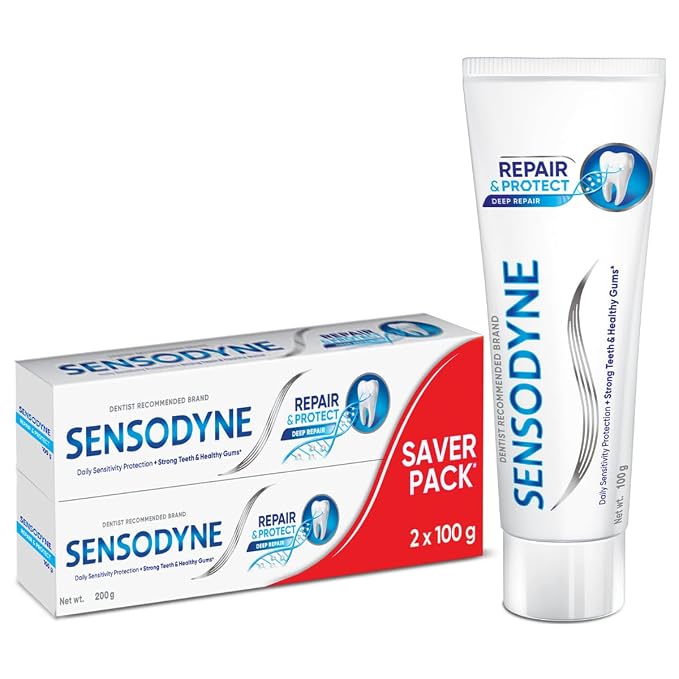
Sensodyne and Parodontax both sit under Haleon, the consumer health group spun out of a British pharmaceutical parent, and between them they own the two clinical segments of the Indian market. Sensodyne is the sensitivity brand with no serious domestic challenger, and the reason is an active ingredient rather than advertising: the Indian formulation contains five percent NovaMin, which forms a hardened hydroxyapatite-like layer over exposed dentine and inside the tubules that carry the pain signal.
This is the case where the Indian market gets the better product. The NovaMin version is sold here and not in the United States, so foreign reviews of Sensodyne Repair and Protect are describing a weaker formulation under the same name. The trade-off worth knowing is that this formula carries sodium fluoride at up to 927 ppm, below the standard adult range, so cavity-prone users should pair it with a full-strength fluoride paste rather than switching entirely.
| Specification | Details |
|---|---|
| Parent group | Haleon, British consumer health group |
| Indian brands | Sensodyne and Parodontax |
| Brand strength | Clinical sensitivity and gum segments |
| Key active | 5 percent NovaMin in the Indian formulation |
| India advantage | NovaMin version not available in the US |
Pros
| Cons
|
4. Himalaya Complete Care

Himalaya occupies a position no other Indian brand has managed: it is bought as a herbal product but manufactured to pharmaceutical-style standards, with a research and quality apparatus closer to a drug company than to a traditional formulator. That combination is why it has built a review base far larger than most natural brands and why it travels well into export markets.
Its genuine strength is mildness. The flavour is gentle enough for children, the colour does not stain a light toothbrush, and the paste foams enough to feel like a proper clean without the intensity of a traditional red or black formulation. For a household that wants a herbal option but finds Dabur Red or a black paste too strong, Himalaya is usually the easiest product to get everyone to agree on.
| Specification | Details |
|---|---|
| Parent group | Himalaya Wellness, Indian-owned |
| Brand strength | Herbal formulations with strict quality control |
| Flavour | Mild, suitable for mixed-age households |
| Range | Complete Care, Sparkly White, Sensitive and others |
| Review volume | Very high for a natural brand |
Pros
| Cons
|
5. Pepsodent Germicheck

Pepsodent and Close Up both belong to Hindustan Unilever, the Indian arm of the Anglo-Dutch consumer group, and together they are the reason Colgate has never had the market to itself. Pepsodent is the family workhorse: a fluoride paste with an antibacterial angle, priced keenly and stocked in essentially every kirana store in the country.
What HUL is genuinely best at is distribution economics. Nothing about Germicheck is technically remarkable, but across a household of four brushing twice a day, the per-gram difference against a premium specialist tube adds up to real money over a year. The smart way to use this brand is as the default for everyone in the house who has no specific dental problem, freeing budget for specialist tubes for the people who do.
| Specification | Details |
|---|---|
| Parent group | Hindustan Unilever, Indian arm of a global group |
| Indian brands | Pepsodent and Close Up |
| Brand strength | Value pricing and unmatched distribution depth |
| Key lines | Germicheck, Expert Protection Gum Care, 2 in 1 |
| Best for | Family default purchasing |
Pros
| Cons
|
6. Patanjali Dant Kanti

Patanjali built Dant Kanti into a national brand in a remarkably short span by combining an ayurvedic formulation with an explicitly swadeshi identity, and it remains the clearest example of an Indian challenger taking share from established multinationals in this category. For a substantial section of Indian households, the fact that the parent company is wholly Indian is itself the buying reason, and that is a legitimate basis for a purchase.
On the product itself, expect a traditional herbal paste with a strong, distinctly non-mint flavour that people either take to immediately or never adjust to. Review volume is solid, though below the two decades of accumulated ratings that Dabur Red and the Colgate lines carry. As with every herbal paste on this page, read the pack for fluoride status rather than assuming it, because the ayurvedic segment is inconsistent on this point.
| Specification | Details |
|---|---|
| Parent group | Patanjali Ayurved, Indian-owned |
| Brand strength | Ayurvedic formulation with a swadeshi identity |
| Flavour | Traditional herbal, strongly non-mint |
| Range | Dant Kanti in several variants and pack sizes |
| Review volume | Solid but younger than the legacy brands |
Pros
| Cons
|
7. Dabur Meswak

Meswak is built around the miswak twig, which has been used as a tooth-cleaning tool across South Asia, the Middle East and parts of Africa for centuries, and it is one of the few Indian pastes organised around a single well-known botanical rather than a long herb list. That focus gives it a distinctive bitter-fresh taste that its users specifically seek out.
Its presence here is also a useful illustration of the ownership point this article is built on. Meswak looks like a competitor to Dabur Red on the shelf, and in fact both belong to the same parent, as do Babool, Dant Rakshak and Promise. If you were choosing between them believing you were comparing rival companies, you were comparing sibling products from one portfolio.
| Specification | Details |
|---|---|
| Parent group | Dabur India, same parent as Dabur Red |
| Core botanical | Miswak, traditionally used for tooth cleaning |
| Flavour | Distinctive bitter-fresh, non-mint |
| Best for | Users who want a single-herb traditional paste |
| Shelf note | A sibling of Dabur Red, not a rival brand |
Pros
| Cons
|
8. Vicco Vajradanti

Vicco is the heritage entry in any honest list of Indian toothpaste brands, an Indian-owned family company whose ayurvedic paste predates most of the shelf and whose jingle is embedded in the memory of an entire generation. It carries the highest star average of any brand on this page, though on a much smaller review sample, so read that number as the verdict of a devoted niche rather than of the mass market.
The product is uncompromisingly traditional: a herb-forward formulation with no attempt at mint freshness, foaming or cosmetic whitening. People who like it tend to have used it for years and will not switch. People trying it for the first time after a lifetime of mainstream paste usually find the absence of foam and cooling disconcerting. It is worth trying precisely because it is so unlike everything else on the shelf.
| Specification | Details |
|---|---|
| Parent group | Vicco Laboratories, Indian family-owned |
| Heritage | One of the oldest ayurvedic oral care brands in India |
| Character | Herb-forward, minimal foam, no mint |
| Star average | Highest on this page |
| Review volume | Small, a devoted niche rather than mass market |
Pros
| Cons
|
9. Close Up Long-Lasting Fresh Breath

Close Up is the second Hindustan Unilever brand in this list and it exists because the company identified early that a large number of buyers care more about how their mouth smells than about cavity statistics. The gel format carries mouthwash-style ingredients alongside fluoride, which is why it doubles as a light rinse in a way an opaque paste does not.
It is worth being straight about the limitation of the whole breath-first category. Persistent bad breath that survives good brushing is usually caused by bacterial coating on the back of the tongue, gum disease, a dry mouth or an untreated cavity. A breath paste masks the symptom well for a few hours, which has genuine social value, but if the smell reliably returns within an hour, the answer is a tongue cleaner and a dental appointment rather than a stronger flavour.
| Specification | Details |
|---|---|
| Parent group | Hindustan Unilever |
| Brand strength | Breath freshness positioning |
| Format | Gel with mouthwash-style ingredients |
| Contains fluoride | Yes |
| Limitation | Masks rather than treats chronic bad breath |
Pros
| Cons
|
10. Perfora Purple Whitening Toothpaste

Perfora represents the newest layer of Indian toothpaste brands: homegrown, direct-to-consumer, design-led and built for online rather than kirana distribution. Alongside names like Dente91, Bentodent and Fang, this group has grown fast by targeting specific concerns with modern packaging and by treating oral care as a considered purchase rather than a commodity.
Approach the segment with clear eyes on both sides. The formulations are often thoughtful and the user experience is usually better than the mass brands. But review volumes are a fraction of the legacy names, which means their averages are less proven, and cost per gram is considerably higher. This particular product is a purple colour-correcting paste, so its effect is optical and temporary rather than a permanent change, a distinction the whole purple category tends to blur.
| Specification | Details |
|---|---|
| Parent group | Perfora, Indian direct-to-consumer brand |
| Segment | New-generation online-first oral care |
| This product | Purple colour-correcting whitening paste |
| Effect type | Optical and temporary, not bleaching |
| Review volume | Solid for a young brand, small against legacy names |
Pros
| Cons
|
The Ownership Map and What Each Brand Is Actually Best At
Fifteen brand names, roughly six corporate groups
An Indian toothpaste shelf looks far more competitive than it is. Colgate-Palmolive covers Colgate and its sub-lines. Hindustan Unilever covers Pepsodent and Close Up. Dabur covers Red, Meswak, Babool, Dant Rakshak and Promise. Haleon covers Sensodyne and Parodontax. Himalaya, Patanjali and Vicco each stand alone as Indian-owned companies. Once you group the shelf this way, choosing becomes a decision between five or six philosophies rather than fifteen packages.
Indian-owned versus Indian-operating is a real distinction
Dabur, Patanjali, Himalaya, Vicco and the newer direct-to-consumer brands are Indian companies. Colgate and Hindustan Unilever are long-established Indian operations of global parents, manufacturing and employing here for decades. Haleon is a foreign group with no Indian manufacturing heritage in the same sense. If swadeshi buying matters to you, the first group is the answer, and it is worth knowing that group includes the single largest-selling ayurvedic paste in the country.
The Indian formula is frequently not the international formula
This is the most practically useful fact in the article. Colgate Total sold in India uses a zinc and arginine antibacterial system with sodium fluoride, while the American version uses stannous fluoride. Sensodyne Repair and Protect sold in India contains five percent NovaMin, which the American version does not. A YouTube comparison filmed abroad may be reviewing a product you cannot buy, and in the Sensodyne case the Indian version is the stronger one.
What each brand is genuinely best at
Colgate for plain fluoride protection at the lowest cost per gram. Haleon for anything clinical, meaning sensitivity through Sensodyne and gum-line plaque through Parodontax. Dabur for the ayurvedic segment at scale with the widest flavour range. Himalaya for a mild herbal paste a whole mixed-age household will accept. Hindustan Unilever for family value buying. Patanjali for buyers who want an Indian-owned ayurvedic option. Vicco for traditionalists who want no mint and no foam.
The fluoride question splits the ayurvedic segment
Several of the biggest herbal and ayurvedic names in India are fluoride-free, and this is stated on their own listings. Dabur Red and Dant Rakshak both declare it. Fluoride is the only toothpaste ingredient with strong replicated evidence for preventing decay, so this is a genuine trade of protection for tradition and flavour. It is a legitimate choice, and it should be a conscious one. If you use a fluoride-free paste and are cavity-prone, discuss varnish or a fluoride rinse with your dentist.
Brand loyalty in this category is unusually strong and usually justified
Toothpaste is repurchased more consistently than almost any other household product, which is why review counts in the tens of thousands exist here and almost nowhere else. That also means a brand with a huge review base has been tested in real conditions for years. When judging a newer name, weigh its star average against how few people have actually tried it, not against the legacy brands as though the samples were comparable.
The direct-to-consumer wave is real but young
Perfora, Dente91, Bentodent, Fang and Salt Oral Care have grown quickly by treating oral care as a considered purchase. Their formulations are often thoughtful and their user experience is better than the mass brands. Their weakness is evidence: a few thousand ratings is not the same signal as forty thousand, and their cost per gram is several times higher. Try them by all means, but do not assume newer means better protected.
Top 10 toothpaste brands in India, ranked by what they solve
If you want a shortlist rather than a shelf, it is Colgate for everyday protection, Sensodyne for sensitivity, Parodontax for gums, Dabur for ayurvedic, Himalaya for mild herbal, Pepsodent for family value, Close Up for breath, Patanjali for swadeshi ayurvedic, Vicco for traditionalists and Perfora for the modern D2C experience. That is ten brands covering ten distinct reasons to buy, which is more useful than ten names ranked by sales.
How to read a toothpaste pack in fifteen seconds
Look for three things and ignore the rest of the panel. Is fluoride listed, and at what parts per million if stated. Is there a named active for your specific problem, such as NovaMin, potassium nitrate, arginine, zinc or sodium bicarbonate. Is sodium lauryl sulphate present, which matters only if you get recurrent mouth ulcers. Everything else on the pack is flavour, texture, colour and marketing.
Brand matters less than matching the tube to the person
The most common mistake in Indian bathrooms is loyalty to one brand for a whole family. The person with receding gums, the smoker with staining, the child who needs a controlled amount and the adult with no complaints all need different tubes, and they will not all come from the same company. Buy by job, not by logo, and let the brand follow the need.
Frequently Asked Questions
Which are the top toothpaste brands of India?
By market presence and review volume the leaders are Colgate, Dabur, Pepsodent, Close Up, Sensodyne, Himalaya, Patanjali, Parodontax, Meswak and Vicco, with a newer direct-to-consumer group including Perfora and Dente91 growing quickly. Each leads in a different segment rather than all competing for the same buyer.
Which toothpaste brands are actually Indian?
Dabur, Patanjali, Himalaya and Vicco are Indian-owned companies, as are the newer direct-to-consumer brands such as Perfora, Dente91 and Bentodent. Colgate and Hindustan Unilever are long-established Indian operations of global parent groups, while Sensodyne and Parodontax belong to a foreign consumer health group.
Which is the number one toothpaste brand in India?
Colgate by scale, distribution and review volume, with Strong Teeth the single most-reviewed toothpaste in the country. In the ayurvedic segment specifically, Dabur leads, and in the clinical sensitivity segment Sensodyne has no serious domestic challenger.
How many toothpaste brands does Dabur own?
Dabur markets several distinct toothpaste brands in India including Red, Meswak, Babool, Dant Rakshak and Promise. They look like competitors on a shelf but belong to one portfolio, which is worth knowing if you think you are comparing rival companies.
Is Colgate an Indian company?
Colgate-Palmolive India is a subsidiary of the American parent group, though it has manufactured and distributed in India for decades and is listed on Indian exchanges. If you specifically want an Indian-owned brand, Dabur, Patanjali, Himalaya and Vicco are the established options.
Which Indian toothpaste brand is best for daily use?
Among Indian-owned brands, Himalaya Complete Care is the easiest all-round daily choice for a mixed household because it is mild and widely accepted. If you specifically want cavity protection from fluoride, check the pack, because several of the biggest Indian herbal pastes are fluoride-free by design.
Are herbal toothpaste brands in India fluoride free?
Some are and some are not, and the segment is inconsistent. Dabur Red and Dant Rakshak both state fluoride free on their listings. Others do contain fluoride. The only reliable method is to read the pack, since the word natural on the front tells you nothing about the ingredient panel on the back.
Why does the same brand have a different formula in India?
Formulations are adapted to local regulation, cost structures and consumer preference. The practical result is that Colgate Total in India is a zinc and arginine formula rather than the stannous fluoride version sold in America, and Sensodyne Repair and Protect in India contains NovaMin while the American version does not. Always check the Indian listing.
Are the new D2C toothpaste brands worth the price?
They generally offer a better user experience and thoughtful formulations, but their review bases are a fraction of the legacy brands and their cost per gram is several times higher. If you enjoy the product and the cost is comfortable, they are a reasonable choice. If you are buying purely on protection, a mainstream fluoride paste does the job for far less.
Which brand is best for sensitive teeth in India?
Sensodyne, and the gap is not close. It is the only brand offering NovaMin at scale in India, and that Indian formulation is stronger than the version sold in the United States. Colgate Sensitive Pro-Relief with arginine is the main alternative if you want a different brand.
Which toothpaste brand is best for gums?
Parodontax from Haleon for a bicarbonate-based approach that keeps fluoride, or Pepsodent Expert Protection Gum Care as a mid-market alternative. Several herbal brands market gum benefits, but many of them drop fluoride, which means treating your gums while losing your decay protection.
Does the brand matter more than the type of toothpaste?
No. The category matters far more than the logo. A fluoride paste from any competent manufacturer prevents decay, and a sensitivity paste with a proper active relieves sensitivity whichever name is on the tube. Choose the category that matches your problem first, then pick whichever brand in that category you can get easily and afford.
Related Guides
Best Toothpaste in India | Top 5 Best Toothpaste in India | Best Whitening Toothpaste in India | Best Toothpaste for Sensitive Teeth | Best Herbal Toothpaste in India | Best Toothpaste for Gums and Bad Breath | Best Toothpaste for Kids in India | Best Electric Toothbrush in India
Conclusion
The toothpaste brands of India look like a crowded shelf and behave like a small group of companies with distinct specialities. Colgate-Palmolive owns scale and cost, Hindustan Unilever owns value and distribution, Dabur owns the ayurvedic segment through five sub-brands that look like rivals but are not, Haleon owns the clinical segments through Sensodyne and Parodontax, and Himalaya, Patanjali and Vicco hold the Indian-owned herbal ground with three quite different philosophies.
The single most useful thing an Indian buyer can know about this category is that the brand name on the front does not guarantee the formula inside. Colgate Total here is a zinc and arginine paste rather than the stannous one reviewed abroad, Sensodyne Repair and Protect here contains NovaMin that Americans cannot buy, and India’s largest-selling ayurvedic paste carries no fluoride at all. None of those are reasons to avoid those products, but all three change which one you should buy.
So use the brand as a shortcut to a speciality rather than as a verdict. Go to Colgate or Pepsodent for ordinary protection in bulk, to Sensodyne for sensitivity, to Parodontax for bleeding gums, to Dabur or Patanjali or Vicco for a traditional paste, and to Himalaya when a household cannot agree. The tube that suits the person beats the brand that suits the family, every time.
Affiliate Disclosure: As an Amazon Associate, we earn from qualifying purchases. This does not affect the price you pay.