Last Updated: August 2026
Sea buckthorn juice is a food, and for most healthy adults a diluted daily serving is unremarkable. That is the honest starting point, and it is worth saying before anything else, because search results for sea buckthorn juice side effects are dominated by pages that either dismiss the question entirely or inflate it.
There are real things to know. The juice is strongly acidic, which matters for your stomach and your tooth enamel. There are specific medication interactions worth checking. There are groups who should ask a doctor before starting. And in India there is an additional practical issue that has nothing to do with the fruit: many commercial bottles contain added sugar or apple juice concentrate, which matters a great deal if you are managing diabetes.
This guide covers all of it plainly, along with the correct way to start, how much is sensible, what to do if something does not agree with you, and how to tell if a bottle has gone off.
Health note: Sea buckthorn juice is a food supplement, not a medicine. Nothing in this guide is medical advice, and it is not intended to diagnose, treat or cure any condition. If you are pregnant, breastfeeding, on blood thinners or blood pressure medication, managing diabetes, or treating any ongoing health condition, speak to a qualified doctor before adding it to your routine.
Is Sea Buckthorn Juice Safe?
Sea buckthorn has been eaten and drunk in Ladakh and across the Himalaya for generations, and it is sold as a food rather than a medicine. For a healthy adult taking a diluted serving once a day, serious problems are not the expectation.
The reasons to be careful are specific rather than general. First, acidity. This is one of the more acidic fruit juices you can buy, and acidity is behind almost every complaint people actually report. Second, a possible effect on platelet activity and on blood pressure, which is why medication interactions deserve a real check rather than a shrug. Third, the fact that research on sea buckthorn supplementation in pregnancy and breastfeeding is not sufficient to give confident advice.
What is not a concern for most people is toxicity at normal food quantities. The problems that arise are usually about dose, dilution, timing and interactions, all of which are manageable once you know about them.
Possible Side Effects and What to Do
Almost everything reported in this category traces back to acidity or to taking too much too soon. The table sets out what people actually experience.
| Effect | Why It Happens | How Likely | What to Do |
|---|---|---|---|
| Stomach discomfort or acidity | Highly acidic juice, often on an empty stomach | Common | Take it after food and reduce the amount |
| Heartburn or reflux | Acidity in someone already prone to reflux | Fairly common | Stop if it persists, discuss with a doctor |
| Loose stools | Too large a dose, or too little dilution | Occasional | Halve the dose and dilute more |
| Tooth sensitivity | Acid contact with enamel, worse if sipped neat | Occasional | Always dilute, rinse with water, delay brushing |
| Nausea | Strong taste and acidity, usually first few days | Occasional | Reduce the dose and take it with food |
| Mild headache | Usually unrelated, sometimes reported early on | Uncommon | Reduce dose, stop if it continues |
| Skin rash or itching | Possible allergy to the fruit | Rare | Stop immediately and seek medical advice |
| Swelling of lips, face or throat | Serious allergic reaction | Very rare | Stop and get urgent medical help |
| Increased bruising or bleeding | Possible platelet effect, usually with medication | Rare | Stop and speak to your doctor |
The pattern is clear. Most of what people call a side effect is a dosing or dilution mistake and disappears when the amount is reduced and the juice is taken with food. The genuinely important entries are the last three, which are uncommon but need action rather than adjustment.
Medication Interactions to Check
This is the section worth taking to your doctor rather than deciding on your own, particularly if you take anything regularly.
| Medication or Situation | Why It Matters | What to Do |
|---|---|---|
| Blood thinners and antiplatelet drugs | Sea buckthorn may affect platelet activity | Ask your doctor before starting |
| Blood pressure medication | Possible additive effect on blood pressure | Ask your doctor, monitor if advised |
| Planned surgery | Bleeding risk considerations | Stop well in advance and tell your surgeon |
| Diabetes medication | Added sugar in many commercial bottles | Read the label, discuss with your doctor |
| Iron supplements | Vitamin C increases iron absorption | Usually helpful, mention it to your doctor |
| High-dose vitamin C supplements | Total intake may become excessive | Check combined intake |
| Other herbal supplements | Overlapping effects are hard to predict | List everything for your doctor |
| Any ongoing medical treatment | Interactions cannot be ruled out generally | Mention it before starting |
None of this means the juice is dangerous. It means that if you take medication, a two-minute conversation before you start is a much better plan than finding out afterwards.
Who Should Avoid It
Anyone on anticoagulants or antiplatelet medication, until a doctor says otherwise. This is the clearest caution in this category.
Anyone with surgery scheduled. Stop in good time and tell your surgeon what you have been taking.
Pregnant and breastfeeding women. There is not enough reliable research on sea buckthorn supplementation in these situations to give a confident answer, so medical advice comes first. Eating the fruit as food is a different matter from taking a concentrate daily.
People with active acid reflux, gastritis or ulcers. A strongly acidic juice is the wrong thing for an already irritated stomach.
Anyone with a known allergy to sea buckthorn or who has reacted to it before.
Young children. The doses on these labels are written for adults, and scaling them down informally is not appropriate. Ask a paediatrician.
People managing diabetes should not avoid the fruit, but must read the ingredient list, because added sugar and apple juice concentrate are common in this category and change the picture entirely.
How Much Is Sensible
Most concentrate labels in India suggest somewhere between 15 and 30 ml, diluted in water, once or twice a day. Ready-to-dilute juices suggest a larger measure because they are already less concentrated. Follow the label on the bottle you bought rather than a figure from an article, because concentration genuinely varies between products.
Start below the label amount. Half the suggested dose for the first week is a sensible approach, both because it lets your stomach adjust and because it tells you quickly whether the acidity suits you at all.
There is no benefit to exceeding the label. Sea buckthorn is not a medicine where more produces more effect, and the extra you drink mostly buys extra acidity. If you find yourself wanting to take more because you are not seeing results, the answer is not a larger dose.
Once or twice a day is enough. Spreading it across four servings adds acid exposure to your teeth without adding benefit.
How to Start Without Problems
Week one, half dose, after food. Take half the label serving, diluted in a full glass of water, after a meal. This is the single most effective way to avoid the discomfort most people report.
Always dilute. Never sip concentrate neat, and never take it as a shot. Beyond the taste, undiluted acid on tooth enamel is the one side effect that does not reverse.
Rinse with plain water afterwards, and wait before brushing. Brushing immediately after anything acidic does more damage than the drink alone.
Week two, adjust upwards if all is well. Move to the full label dose only if the half dose caused no discomfort.
Move it to a different time if needed. If mornings on an empty stomach do not suit you, take it after lunch instead. Timing has no effect on nutritional value.
Stop if something is clearly wrong. Persistent pain, a rash, or any swelling means stop, not push through.
Storage, Spoilage and Safety
Refrigerate after opening, and finish the bottle within the period stated on the label. Sea buckthorn carotenoids and berry oils degrade with heat and light, which is why the same bottle left on a sunny kitchen shelf loses value faster than one in the fridge.
Natural separation is normal and is a sign the juice has not been heavily processed. Shake before use. What is not normal is a fizzy or yeasty smell, a bulging bottle, visible mould, or a taste that has turned sharp in a different way from the usual sourness. Any of those means discard it rather than risk it.
Check the seal on delivery. Reports of leaking or damaged bottles are common enough in this category that it is worth inspecting before you drink. A bottle that arrived already open should be returned, not consumed.
Keep it away from children, not because it is dangerous but because a curious child drinking concentrate neat will have a very unpleasant experience.
Label Red Flags in India
Added sugar or sucrose. Common in this category and the single most relevant item if you are managing diabetes or watching sugar intake.
Apple juice concentrate. Used as a sweetener and diluent. It is technically not added sugar, which is exactly why it appears.
No stated pulp percentage. Not a safety issue, but it tells you the brand would rather you did not know how much of the bottle is actually sea buckthorn.
Cure claims on the label or listing. A seller willing to claim their juice treats a disease is a seller whose other claims deserve no trust either.
No Indian company details. For a consumable, an unreachable seller means no accountability if a batch is wrong.
No batch number or expiry. Basic labelling requirements. Their absence is reason enough to return the bottle.
Safest Sea Buckthorn Juices to Buy in India
For a first purchase, the things that matter are clear labelling, no added sugar, honest serving guidance and a large body of prior buyers. These four were checked against live Amazon India ratings and verified review counts in August 2026.
| Product | Best For | Rating | Buy |
|---|---|---|---|
| Ayuzera (Wellwith) Himalayan Sea Buckthorn Pulp Concentrate 300ml | Safest Default Choice | 4.0 ⭐ (5,400+) | Check Price |
| Kapiva Sea Buckthorn Juice 500ml | Best Labelling and Disclosure | 4.0 ⭐ (300+) | Check Price |
| Nutriorg Pure Sea Buckthorn Juice Concentrate 500ml | Best Certified Organic Option | 3.9 ⭐ (550+) | Check Price |
| Fytika Sea Buckthorn Juice 300ml | Best Small Bottle to Test Tolerance | 4.0 ⭐ (1,360+) | Check Price |
1. Ayuzera (Wellwith) Himalayan Sea Buckthorn Pulp Concentrate 300ml — Safest Default Choice
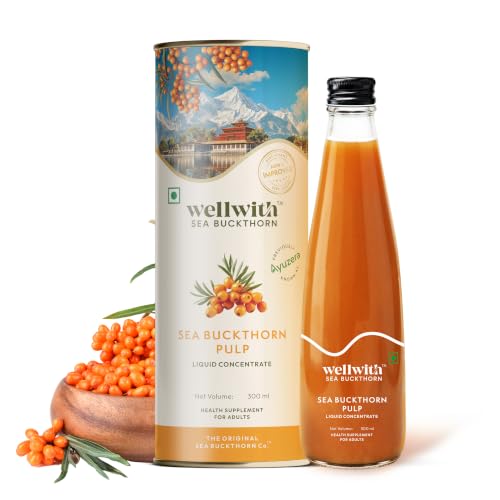
When the question is safety rather than potency, the most useful thing about a product is how many people have already consumed it. This concentrate has a verified review base larger than every other sea buckthorn product in India combined, which means a very large number of households have taken it over a sustained period. That is not a clinical trial, but it is the closest thing to a safety record available in a category where nobody publishes analysis reports.
It is an undiluted cold-pressed pulp from wild Nubra Valley berries, and being a concentrate it is designed to be diluted, which is also the safest way to take anything this acidic. A small measure in a full glass of water reduces the contact time with tooth enamel and the load on an empty stomach. Read the serving instruction rather than guessing, and start below it for the first week, because the most common complaint about this product is simply that people underestimated how sour and strong it is.
| Specification | Details |
|---|---|
| Format | Undiluted pulp concentrate |
| Bottle size | 300 ml |
| Added sugar | None declared |
| Typical serving | About 15 to 20 ml in water |
| Dilution | Required, never drink neat |
| Storage | Refrigerate after opening |
Pros
| Cons
|
2. Kapiva Sea Buckthorn Juice 500ml — Best Labelling and Disclosure

For anyone with a medical reason to read labels carefully, and diabetes is the clearest example, disclosure matters more than provenance. Kapiva states explicitly that this juice is free from added sugar, colours and artificial flavours, and its labelling is held to a consistent standard across a large mainstream product range rather than varying listing to listing.
That accountability is the reason it appears here. A recognisable Indian wellness brand with wide retail distribution has both a customer service function you can reach and a reputation to protect, which is not true of every listing in this category. The juice is sourced from high-altitude Ladakh and is lighter than the thick specialist pulps, which for a first-time user is arguably an advantage since it is gentler on the stomach. If you need to be certain what is in the bottle, this is the least ambiguous option here.
| Specification | Details |
|---|---|
| Format | Ready-to-dilute juice |
| Bottle size | 500 ml |
| Free from | Added sugar, colours, artificial flavours |
| Consistency | Lighter than specialist pulps |
| Typical serving | About 20 to 30 ml in water |
| Best suited to | Buyers who must read labels carefully |
Pros
| Cons
|
3. Nutriorg Pure Sea Buckthorn Juice Concentrate 500ml — Best Certified Organic Option

Organic certification does not make a juice safer to drink, but it does mean an independent body has audited how the crop was grown, which is a meaningful check in a category where most claims are self-declared. Nutriorg sits inside a certified organic range and has been selling this cold-pressed Ladakh concentrate for longer than most competing listings have existed.
The 500 ml concentrate carries no added sugar and, being a concentrate, is intended for dilution. Its rating is the lowest among the established options here, and the reviews are worth reading honestly: complaints centre on the taste, on a thinner consistency than premium pulps, and on packaging arriving damaged in transit. Damaged packaging is a genuine safety point rather than a cosmetic one, so check the seal on arrival and do not drink from a bottle that arrived leaking or already open.
| Specification | Details |
|---|---|
| Format | Cold-pressed concentrate |
| Bottle size | 500 ml |
| Certification | Certified organic range |
| Added sugar | None declared |
| Typical serving | About 20 to 30 ml in water |
| Note | Check the seal on delivery |
Pros
| Cons
|
4. Fytika Sea Buckthorn Juice 300ml — Best Small Bottle to Test Tolerance

The sensible way to find out whether your stomach tolerates a strongly acidic juice is to buy a small bottle rather than a large one. Fytika is the most approachable option here for exactly that reason: a 300 ml pulp concentrate with clearer serving guidance than most listings in the category, which reduces the chance of the most common mistake, which is taking too much on the first day.
The review base is large for a relatively new listing and the rating has stayed stable, suggesting people generally get what they expected. If the acidity does not suit you, you will know within a week or two and you will not have a 500 ml bottle sitting unused. What the brand does not do is specify sourcing as precisely as the Himalayan specialists, which matters less for a tolerance test than it would for a long-term purchase.
| Specification | Details |
|---|---|
| Format | Pulp concentrate |
| Bottle size | 300 ml |
| Serving guidance | Clearer than most listings |
| Typical serving | About 15 to 20 ml in water |
| Added sugar | None declared |
| Best suited to | Testing tolerance before committing |
Pros
| Cons
|
When to Stop and See a Doctor
Stop immediately and seek medical help for swelling of the lips, face, tongue or throat, difficulty breathing, or a widespread rash. These are signs of a serious allergic reaction and are a medical emergency rather than something to monitor.
Stop and speak to your doctor for unusual bruising or bleeding, including bleeding gums or nosebleeds, particularly if you take blood thinning medication. Also for stomach pain that persists after you reduce the dose and take it with food, or for any new symptom that started when you started the juice.
Do not simply push through discomfort on the assumption that it means the supplement is working. Nothing about sea buckthorn juice requires you to feel unwell, and discomfort is information rather than progress.
Frequently Asked Questions (2026)
Does sea buckthorn juice have side effects?
For most healthy adults taking a diluted serving, no more than mild acidity or stomach discomfort, usually caused by taking too much or drinking it on an empty stomach. Rarely, allergic reactions occur. The important cautions involve blood thinners, blood pressure medication, surgery, pregnancy and breastfeeding.
Who should not drink sea buckthorn juice?
Anyone on anticoagulant or antiplatelet medication until a doctor approves, anyone with surgery scheduled, pregnant and breastfeeding women without medical advice, people with active reflux, gastritis or ulcers, anyone allergic to it, and young children without paediatric advice.
Can I drink sea buckthorn juice every day?
Most healthy adults can take a diluted serving once or twice daily as the label directs. Start with half the suggested amount for the first week, take it after food, and always dilute it in a full glass of water.
Is sea buckthorn juice safe in pregnancy?
There is not enough reliable research on supplementation during pregnancy or breastfeeding to give a confident answer, so this is a question for your doctor rather than an article.
Can it cause acidity or heartburn?
Yes, and this is the most commonly reported issue. It is one of the more acidic juices available. Taking it after a meal, reducing the amount and diluting it more usually resolves it. If reflux persists, stop and speak to a doctor.
Does it damage teeth?
Repeated contact with any strongly acidic drink can erode enamel over time, especially if sipped neat or slowly. Dilute it in a full glass, drink it rather than sipping over an hour, rinse with plain water afterwards and wait before brushing.
Can diabetics drink sea buckthorn juice?
The fruit itself is not the concern. The problem is that many commercial bottles contain added sugar or apple juice concentrate. Read the ingredient list, choose a product with no added sugar, and discuss it with your doctor.
Does it interact with blood thinners?
It may, because sea buckthorn has been associated with effects on platelet activity. If you take warfarin, aspirin or any antiplatelet or anticoagulant medication, ask your doctor before starting and mention it before any surgery.
How much sea buckthorn juice is too much?
Anything above the label serving offers no additional benefit and adds acidity. For most concentrates the label suggests 15 to 30 ml diluted, once or twice a day. Exceeding that is where stomach upset and loose stools begin.
How do I know if the juice has gone bad?
A fizzy or yeasty smell, a bulging bottle, visible mould, or a taste that has turned sharp in an unfamiliar way. Natural separation and settling are normal and are not signs of spoilage. When in doubt, discard it.
Related Guides
Best Sea Buckthorn Juice in India · Sea Buckthorn Juice Benefits · Best Sea Buckthorn Juice Brand in India · Sea Buckthorn Juice for Skin
Conclusion
For most healthy adults, sea buckthorn juice is a food with no meaningful side effects when it is diluted properly and taken at the amount the label suggests. Nearly everything people report comes down to acidity, and acidity is solved by diluting more, taking it after a meal, and starting at half the suggested dose for the first week.
The cautions that genuinely matter are specific. If you take blood thinners or blood pressure medication, have surgery planned, are pregnant or breastfeeding, or have an irritated stomach, ask a doctor before starting rather than after. If you are managing diabetes, the fruit is not the issue, the added sugar in many Indian bottles is, so read the ingredient list.
Buy a product with clear labelling and no added sugar, refrigerate it after opening, never sip it neat, and stop rather than push through if something is clearly wrong. Taken that way, this is one of the lower-risk supplements you can add to a diet.