


Last Updated: August 2026
Buying a smart plug for AC use is the one case in this category where getting it wrong has real consequences. An air conditioner is a high-current appliance with a compressor that surges hard at startup, and a ten amp plug bought because it was cheaper will run warm, degrade and eventually fail at the socket. Every recommendation below is a genuine 16A device, checked against live Amazon India ratings and verified review counts in August 2026.
There is a second thing worth settling before you buy. A smart plug cuts power to the air conditioner. It does not change the temperature, the mode or the fan speed, and when power is restored most ACs do not resume their previous settings on their own. If what you actually want is to pre-cool the bedroom before you reach home, you want an infrared controller instead, or both devices working together. This guide explains exactly where the line sits.
For appliances other than cooling, our broader roundup of the best smart plug in India covers 10A options too, and the dedicated 16A smart plug guide goes deeper into heavy-load maths.
Quick Comparison Table
| Product | Best For | Rating | Buy |
|---|---|---|---|
| Wipro 16A Wi-Fi Smart Plug | Best Overall for Air Conditioners | 4.2 ⭐ (18,800+) | Check Price |
| TP-Link Tapo P110 16A Smart Plug | Best for Tracking Cooling Costs | 4.5 ⭐ (2,800+) | Check Price |
| Havells 16A Wi-Fi Smart Plug | Best Heavy-Duty Build for AC Points | 4.0 ⭐ (1,600+) | Check Price |
| AZIOT 16A Smart Plug | Best for Homes with Patchy Internet | 4.3 ⭐ (390+) | Check Price |
| Smarteefi 16A Smart Plug with Guaranteed Timer | Best for Night-Time AC Schedules | 4.5 ⭐ (270+) | Check Price |
| HomeMate 16A Wi-Fi Smart Plug | Best for Multi-Room AC Control | 4.1 ⭐ (1,400+) | Check Price |
Top 6 Smart Plugs for AC in India Reviewed
1. Wipro 16A Wi-Fi Smart Plug — Best Overall for Air Conditioners


An air conditioner is the appliance most likely to expose a weak smart plug, and this is the model Indian households have run on theirs more than any other. Its 16A rating comfortably covers a 1 ton or 1.5 ton split unit, and the enormous verified review base means the compressor surge behaviour has been tested in real bedrooms across full summers rather than in a lab. That evidence is the single strongest argument for it.
The practical value on an AC comes from two features. Energy monitoring shows units consumed per session, which is how you find out whether running the unit at a higher set temperature genuinely changes your bill or only your comfort. Scheduling handles the habit most households never fix, which is the AC left running in an empty bedroom in the morning. Set a cut-off at the hour everyone leaves and the plug pays for itself quickly. It restores its previous state after a power cut, so an evening schedule survives an afternoon outage.
| Specification | Details |
|---|---|
| Current rating | 16A |
| Suited to | 1 ton and 1.5 ton split or window AC |
| Energy monitoring | Units consumed per session |
| Power cut behaviour | Restores last state |
| Voice assistants | Alexa and Google Assistant |
| Scheduling | Daily, weekly and countdown |
Pros
| Cons
|
2. TP-Link Tapo P110 16A Smart Plug — Best for Tracking Cooling Costs

Air conditioning is usually the largest single line in an Indian summer electricity bill, and the P110 is the plug that actually lets you see it. Its hourly consumption graphs show how many units the unit pulled between eleven at night and six in the morning, which is the sort of data that settles arguments about thermostat settings and sleep mode. Weekly and monthly views then show whether a change in habit is working.
It handles the electrical side without drama, carrying a 1.5 ton inverter split unit well inside its rating, and it reconnects to Wi-Fi more dependably than most plugs after the outages that plague Indian summers. Physically it is compact for a 16A device, which helps at an AC socket mounted high in a corner. What it cannot do, like every plug, is control temperature or mode. It switches supply, nothing more, so pair it with the unit remote rather than expecting it to replace one.
| Specification | Details |
|---|---|
| Current rating | 16A |
| Suited to | 1 ton and 1.5 ton inverter split AC |
| Energy monitoring | Hourly, weekly and monthly graphs |
| Connectivity | Wi-Fi 2.4GHz |
| Voice assistants | Alexa and Google Assistant |
| Automation | Scenes and sunset triggers |
Pros
| Cons
|
3. Havells 16A Wi-Fi Smart Plug — Best Heavy-Duty Build for AC Points


An air conditioner socket carries a serious sustained load for hours at a stretch, and contact quality at the pins matters as much as the electronics behind them. This is where an electrical-hardware brand has an edge. The Havells plug seats firmly in a 16A socket, the housing is dense, and the finish is closer to a wiring accessory than a consumer gadget, which is reassuring on a point that will run six hours a night through summer.
It is explicitly rated for air conditioners, geysers, room heaters and air coolers, and includes consumption tracking plus Alexa and Google Assistant control. The app is functional rather than sophisticated: schedules, timers and usage history are all there, but there is no scene building or cross-device automation. If your priority is a robust device from a brand your electrician already stocks, with service available offline in almost any Indian city, this is the practical choice for an AC point.
| Specification | Details |
|---|---|
| Current rating | 16A |
| Suited to | Split and window AC, air cooler |
| Energy monitoring | Yes |
| Build | Heavy-duty electrical-grade housing |
| Voice assistants | Alexa and Google Assistant |
| Service | Nationwide offline network |
Pros
| Cons
|
4. AZIOT 16A Smart Plug — Best for Homes with Patchy Internet
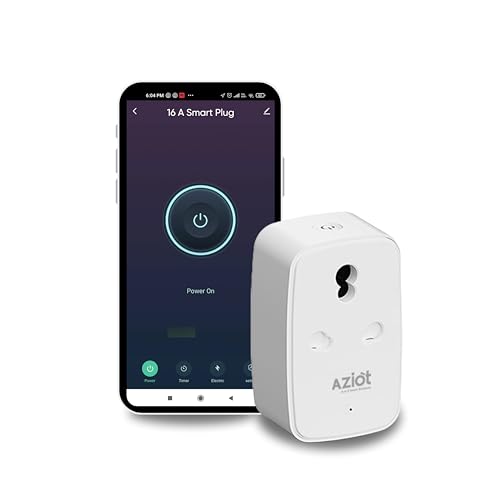
Summer in India means power cuts, and power cuts mean routers rebooting and broadband dropping exactly when the air conditioner needs switching. This plug answers that with a second radio: alongside Wi-Fi it carries Bluetooth, so within the house you can still control the AC from your phone when the connection is down. Combined with a 16A rating and energy monitoring, it is a sensible bedroom choice in a home where the internet is not dependable.
It runs through the widely used Smart Life app, which means it can share a dashboard with other Tuya-based devices you may already own, and it supports Alexa and Google Assistant for voice control. The rating is strong, though the review base is far smaller than the market leaders, so there is less accumulated evidence on multi-season use. As a value 16A plug for an AC point where offline control matters, it makes a clear case for itself.
| Specification | Details |
|---|---|
| Current rating | 16A |
| Suited to | Split AC, air cooler, geyser |
| Connectivity | Wi-Fi 2.4GHz plus Bluetooth |
| Energy monitoring | Yes |
| App | Smart Life |
| Voice assistants | Alexa and Google Assistant |
Pros
| Cons
|
5. Smarteefi 16A Smart Plug with Guaranteed Timer — Best for Night-Time AC Schedules


The most useful air conditioner automation is also the one most likely to fail on an ordinary smart plug: cutting power at three in the morning when the room is already cold. On cloud-dependent plugs that schedule quietly does nothing if the internet happens to be down. Smarteefi stores schedules on the device itself, so the cut-off runs whether or not the broadband is working, and resumes correctly after a power cut.
The rest is standard 16A capability, with app control, countdown timers and voice support through Alexa and Google Assistant. It is the most expensive plug in this guide and comes from a small Indian brand with a modest review base, which is the trade-off for the one feature nobody else here guarantees. If your reason for buying is a dependable nightly AC cut-off rather than remote convenience, it is the most purpose-built option available.
| Specification | Details |
|---|---|
| Current rating | 16A |
| Scheduling | Stored on device, runs offline |
| Suited to | Overnight AC cut-off automation |
| Power cut behaviour | Schedules resume automatically |
| Voice assistants | Alexa and Google Assistant |
| Connectivity | Wi-Fi 2.4GHz |
Pros
| Cons
|
6. HomeMate 16A Wi-Fi Smart Plug — Best for Multi-Room AC Control


Households with more than one air conditioner run into a small daily annoyance: switching each unit separately from separate tiles in an app. HomeMate solves it with grouping, letting you control the bedroom and living room plugs as a single object, so one command at bedtime or one cut-off in the morning covers the whole house. Add Siri shortcut support alongside Alexa and Google Assistant, and every member of a mixed-phone household can use it.
Electrically it is a standard 16A unit with energy monitoring, rated for air conditioners, geysers, heaters and microwaves, from a brand that has been in Indian home automation longer than most. The body is large, which is normal at this rating but worth checking if the AC socket sits inside a recessed switchboard. As always the plug wants a solid 2.4GHz signal at the socket rather than at the router across the flat.
| Specification | Details |
|---|---|
| Current rating | 16A |
| Grouping | Control several AC plugs at once |
| Energy monitoring | Yes |
| Voice assistants | Alexa, Google Assistant and Siri shortcuts |
| Suited to | Multi-room air conditioning |
| Connectivity | Wi-Fi 2.4GHz |
Pros
| Cons
|
AC Tonnage, Wattage and the Plug You Need
Indian mains runs at about 230 volts, so an air conditioner drawing 1800 watts pulls roughly eight amps. That fits inside a 16A plug with room to spare, and it is well outside what a 10A plug should be asked to carry once startup surge is included. Inverter units draw less on average than older fixed-speed models, but the surge at compressor start is what dictates the rating, not the average.
Use the table to place your own unit.
| Air Conditioner | Running Power | Current Drawn | Recommendation |
|---|---|---|---|
| 1 ton inverter split | 900 to 1200 W | 4 to 5 A | 16A plug is comfortable |
| 1 ton window AC | 1100 to 1400 W | 5 to 6 A | 16A plug is comfortable |
| 1.5 ton inverter split | 1400 to 1800 W | 6 to 8 A | 16A plug is comfortable |
| 1.5 ton non-inverter split | 1700 to 2100 W | 7 to 9 A | 16A plug, avoid extension boards |
| 1.5 ton window AC | 1600 to 2000 W | 7 to 9 A | 16A plug is suitable |
| 2 ton split AC | 2200 to 2600 W | 10 to 11 A | Check socket type before buying |
| 2 ton and above, non-inverter | 2600 W and up | 11 A and up | Use a smart contactor instead |
| Portable AC | 1000 to 1500 W | 4 to 7 A | 16A plug is suitable |
Two practical warnings. First, never run an air conditioner through an extension board, whatever plug you use. The AC should go into its own wall socket, and the smart plug should sit directly in that socket. Second, if your AC point uses an industrial-style socket rather than a standard 16A round-pin one, no domestic smart plug will fit and forcing an adaptor into that path is a fire risk rather than a workaround.
What a Smart Plug Cannot Do for an AC
It cannot change the temperature. A plug only interrupts supply, so set points, fan speeds, swing and modes remain entirely under the control of the unit and its remote.
It usually cannot restart the AC in a usable state. Most Indian air conditioners power up in standby when supply returns and wait for a remote command. So switching the plug on from your office does not cool the room before you arrive, it only makes the unit ready to be switched on. A few models with auto-restart do resume, and that setting is worth checking in your manual before you build any automation around it.
It cannot protect against voltage problems on its own. A smart plug is not a stabiliser and does not offer the low or high voltage cut-off that AC circuits often need in Indian conditions. If your supply swings, a dedicated voltage protector remains a separate purchase.
What it does well is the opposite end of the problem: cutting power completely so the unit draws nothing overnight or while the house is empty, giving you a switch-off from anywhere when someone forgets, and measuring what the AC consumed.
Smart Plug or Smart AC Remote: Which One Do You Actually Need?
A smart infrared controller replaces the AC remote and can set temperature, mode and fan speed from an app or by voice. A smart plug replaces the wall switch and can only cut or restore power. The two are complements, not competitors.
Buy a smart plug if your goal is to stop the AC running in an empty room, to enforce a nightly cut-off, or to see how many units the unit consumes. Buy a smart infrared controller if your goal is to pre-cool a room before you arrive or to change the set temperature by voice. Homes that want both typically leave the plug permanently on during the season and use the remote controller for daily operation, switching the plug off only when the room will be unused for days.
The one thing to avoid is buying a plug expecting remote-controller behaviour. It is the most common source of one-star reviews in this category, and it is a mismatch of expectation rather than a fault in the product.
How to Choose a Smart Plug for AC
Insist on a genuine 16A rating. Not a 6A to 16A adaptable claim with a converter in the box, but a plug with thick pins moulded for a 16A socket. This is the single most important decision.
Check the socket and the clearance. AC points are often mounted high, sometimes inside a recess. Measure before buying a bulky plug, and confirm the point is a real 16A socket rather than a 6A one that somebody adapted.
Prefer energy monitoring. An air conditioner is the appliance most worth measuring, because small habit changes translate into visible units. A plug without monitoring on an AC wastes the best reason to own one.
Decide what should happen after a power cut. If the plug restores power automatically, the AC returns to standby and waits. If it stays off, your schedule may not run. Neither is wrong, but you should know which behaviour you are buying.
Favour local scheduling for overnight cut-offs. If the plug exists to switch the AC off at three in the morning, a cloud-only schedule that fails during an outage defeats the purpose.
Check Wi-Fi strength at the AC socket. Bedroom AC points are often at the far end of the flat from the router. Test the signal there before assuming any plug will behave.
Can a Smart Plug Cut Your Summer Bill?
Yes, but through behaviour rather than hardware. The saving does not come from the plug being efficient. It comes from the air conditioner not running when nobody needs it.
Three patterns account for most of the benefit. The first is the empty-room cut-off, where the unit keeps running after everyone has left for work and a schedule ends it. The second is the overnight cut-off, when a room is already cold by two or three in the morning and continued cooling adds units without adding comfort. The third is the standby draw of the unit itself, small but continuous across a whole season.
Energy monitoring is what makes these visible. Once you can see units consumed per night, testing a one degree change in set temperature or an earlier cut-off becomes a measurable experiment rather than a guess. That is the real return on a smart plug attached to an air conditioner.
Frequently Asked Questions (2026)
Can I use a smart plug for an AC?
Yes, provided it is rated at 16A and the air conditioner is within its capacity. A 1 ton or 1.5 ton unit draws roughly four to nine amps while running, which a quality 16A plug handles comfortably. Never use a 10A plug on an air conditioner.
Which smart plug is best for a 1.5 ton AC?
The Wipro 16A is the most proven choice in Indian homes, and the Tapo P110 is the better pick if you want detailed hourly energy data. Both carry a 1.5 ton split unit well inside their rating.
Will a smart plug turn my AC on remotely?
It restores power, but most air conditioners then sit in standby waiting for a remote command rather than resuming cooling. Only units with an auto-restart feature come back on by themselves. For genuine remote starting, a smart infrared controller is the right device.
Can a smart plug handle a 2 ton AC?
Usually yes on paper, since a 2 ton unit draws roughly ten to eleven amps, but the margin is smaller and the socket type matters. For larger or non-inverter units above that, a smart contactor wired by an electrician is the safer solution.
Does a smart plug protect the AC from voltage fluctuation?
No. A smart plug is a switch, not a stabiliser, and it does not provide low or high voltage cut-off. Keep any voltage protection you already use in the circuit.
Is it safe to leave a smart plug connected to an AC all summer?
Yes, when it is a branded 16A plug plugged directly into a matching wall socket with no adaptors in between. Check occasionally that the plug and socket are not running warm, which would indicate a contact problem.
Does a smart plug save electricity on an air conditioner?
It enables savings by cutting power when cooling is not needed, such as after everyone leaves in the morning or late at night when the room is already cold. The plug itself consumes under a watt while idle.
Can I use one smart plug for two air conditioners?
No. Each AC needs its own wall socket and its own plug. Combining two heavy loads on one plug exceeds the rating and is unsafe.
Do smart plugs work with inverter ACs?
Yes. Inverter units actually draw less average current than older fixed-speed models. The rating requirement is driven by the startup surge, which a 16A plug is built to absorb.
What happens to the AC when the plug switches off during operation?
It is equivalent to a power cut. The compressor stops immediately. Modern units tolerate this, but avoid rapid on and off cycling, as compressors need a few minutes between restarts.
Related Guides
Best Smart Plug in India · Best 16A Smart Plug in India · Best Smart Plug with Energy Monitoring · Best Smart LED Bulb in India · Best Smart Plug for Alexa · Best Smart Plug Brand in India · Best Smart Extension Board
Conclusion
For most air conditioners in India, the Wipro 16A is the plug to buy. It is rated correctly for the load, it has been used on more Indian AC points than any competitor, it restores its state after a power cut, and it measures what the unit consumes so you can act on the number.
Pick the Tapo P110 instead if the cooling bill is what you really want to understand, since nothing else here shows consumption hour by hour. Pick the Smarteefi if a nightly cut-off must work whether or not the internet does, the Havells if a heavy-duty build with offline service matters most, the AZIOT if Bluetooth control during outages appeals, and the HomeMate if you are automating more than one air conditioner at once.
Whichever you choose, put it directly into a genuine 16A wall socket, keep extension boards out of the path, and remember that the plug controls power, not temperature.