Last Updated: August 2026
Searching for organic sea buckthorn juice in India puts you in the strangest corner of this whole category, because almost every bottle already claims to be pure, natural, organic and preservative free, and almost none of them can be checked. Pure is not a regulated word. Natural means nothing. Organic does mean something, but only when a certification body stands behind it rather than a graphic designer.
There is also a genuine complication nobody explains. Indian sea buckthorn grows largely wild along the riverbeds of Ladakh rather than on managed farms. Wild fruit is often free of agricultural inputs by default, but wild harvests are harder to bring under a formal organic certification scheme than a farmed crop is. So the most authentic-sounding claim in this category, wild-harvested, and the most official-sounding one, certified organic, are not two grades of the same thing. They are different claims, and understanding that is how you avoid paying a premium for a word.
This guide covers what each claim actually means, which preservatives are used in this category and whether they matter, how cold pressing changes what is in the bottle, the label signals that separate a real product from a repackaged one, and the six options Indian buyers rate most consistently.
Health note: Sea buckthorn juice is a food supplement, not a medicine. Nothing in this guide is medical advice, and it is not intended to diagnose, treat or cure any condition. If you are pregnant, breastfeeding, on blood thinners or blood pressure medication, managing diabetes, or treating any ongoing health condition, speak to a qualified doctor before adding it to your routine.
What Organic Actually Means Here
Organic is a production standard, not a quality rating. It refers to how the crop was grown and processed, principally the avoidance of synthetic pesticides and fertilisers, and it is verified by a certification body that audits the producer. In India the relevant schemes include the national organic programme and the Jaivik Bharat mark, alongside international certifications that exporters often hold.
What organic does not mean is more nutritious, more concentrated, or better tasting. A certified organic juice that has been diluted with water and apple juice concentrate is a worse product than an uncertified undiluted pulp, and no certification changes that. Certification tells you about the farm, not about how much sea buckthorn is in your glass.
The practical distinction to hold on to is between a brand with a certified organic range, which has an audit trail behind the claim, and a listing that simply uses the word organic in its product title. Both appear identical in search results. Only one of them has been checked by anybody.
Wild-Harvested vs Certified Organic
This is the part of the category that confuses buyers most, and it is specific to sea buckthorn in India.
| Factor | Wild-Harvested | Certified Organic |
|---|---|---|
| What it describes | Fruit picked from plants growing naturally | Fruit grown under an audited standard |
| Typical Indian source | Ladakh riverbeds and high valleys | Managed plantations or certified collection |
| Agricultural inputs | Usually none by default | Prohibited and verified |
| Verified by | Usually nobody, it is a brand claim | A certification body |
| Batch consistency | Varies with season and harvest | More standardised |
| What it tells you about purity | Suggests no farm chemicals | Confirms no farm chemicals |
| What it does not tell you | Whether the juice was diluted after | Whether the juice was diluted after |
| Common in this category | Very common claim | Genuinely uncommon |
Read the last two rows together, because they are the point. Neither claim says anything about what happened between the harvest and the bottle. A wild-harvested, certified-organic juice can still be sixty percent water with apple juice concentrate added for taste, and the front label will still be truthful. Dilution is a separate question from cultivation, and it is the question that actually determines what you are drinking.
Preservatives: What Is Used and Does It Matter
Sea buckthorn is naturally very acidic, and acidity is itself a preservative. That is why many products in this category can honestly claim no added preservatives, and it is also why the ones that do use them typically need very little.
Where preservatives do appear in Indian fruit juices, the usual candidates are sodium benzoate and potassium sorbate, both permitted food additives used at small quantities to prevent yeast and mould growth after opening. They are declared on the ingredient list, so you can check in seconds.
Whether their absence matters depends on what you actually care about. If you prefer a minimal ingredient list on principle, preservative free is a reasonable preference and is easy to find here. If you are expecting a health difference, the evidence for harm from these additives at permitted food levels is not strong, and there are bigger things on a label to worry about, starting with added sugar.
The real trade-off is practical. A preservative-free juice has a shorter window after opening and depends on you refrigerating it properly. That is a fair price for a shorter ingredient list, but it is a price, and it is the reason spoilage complaints cluster around the purest products in this category rather than the most processed ones.
Cold-Pressed vs Heat-Treated
Of all the processing words used in this category, cold-pressed is the one that changes what is in the bottle. Sea buckthorn carries carotenoids and berry oils that degrade with heat, so a juice extracted and packed without a heat step retains more of the components that make the fruit distinctive.
Heat treatment is not wrong. Pasteurisation exists because it makes a juice safer and more stable, and for a mass-market product with a long shelf life it is a rational choice. What it costs is some of the heat-sensitive content, and in a fruit valued specifically for carotenoids and oils, that cost is more relevant than it would be in an apple juice.
You can see the difference. A minimally processed sea buckthorn product is thick, cloudy, deep orange and separates on standing, needing a shake before use. A heavily processed one is thinner, more uniform and more stable in the bottle. Separation is a feature rather than a fault, and a product that never separates has usually been homogenised or diluted.
How to Read the Label
Read the ingredient list first, not the front. Sea buckthorn should be first and ideally alone. Water is expected in a diluted juice. Apple juice concentrate, sugar, sucrose and artificial flavour are the entries that change what you are buying.
Look for a stated pulp percentage. Almost nobody publishes one, which is exactly why a brand that does deserves credit. It is the single most informative number that could appear on these bottles.
Check whether organic is certified or just printed. Look for a certification mark and a certifier name. The word alone in a product title has been verified by nobody.
Find the origin. Ladakh, Nubra Valley, Himachal and Uttarakhand are specific. Himalayan on its own spans several countries.
Confirm batch number, packing date and expiry. Basic requirements, and their absence is reason enough to return a bottle.
Note the after-opening window. Preservative-free products state a shorter period. If the label says nothing at all about storage, that itself is a signal about the care taken.
Purity Signals You Can Actually Check
No consumer test proves a sea buckthorn juice is genuine. What you can do is observe the things that are hard to fake once the bottle is open.
| Signal | What a Genuine Product Does | What Suggests Dilution |
|---|---|---|
| Colour | Deep, opaque orange | Pale, translucent or yellowish |
| Texture | Thick, cloudy, coats the glass | Thin and watery |
| Separation | Settles on standing, needs shaking | Stays perfectly uniform |
| Taste | Aggressively sour with a resinous finish | Mild, sweet or bland |
| Smell | Sharp, distinctive, slightly oily | Faint or generically fruity |
| Dose on label | A small measure, diluted | A large measure, or drink as is |
| Ingredient list | Sea buckthorn alone or with water | Apple juice concentrate or sugar |
| Stain | Stains cloth strongly | Washes out easily |
Taste is the most reliable of these in practice. Real sea buckthorn is unpleasant on the first encounter, and a product marketed on tasting great almost always contains something that is not sea buckthorn. In this one category, a drink being hard to like is evidence in its favour.
Best Organic Sea Buckthorn Juices in India
Ranked on the strength of what can actually be verified: certification where it genuinely exists, undiluted formats, cold pressing, and the weight of buyer evidence. All checked against live Amazon India ratings and verified review counts in August 2026.
| Product | Best For | Rating | Buy |
|---|---|---|---|
| Nutriorg Pure Sea Buckthorn Juice Concentrate 500ml | Best Certified Organic Brand | 3.9 ⭐ (550+) | Check Price |
| Nutrabud Organics Himalayan Sea Buckthorn Berry Juice 500ml | Best Rated Organic-Range Option | 4.2 ⭐ (2,600+) | Check Price |
| Ayuzera (Wellwith) Himalayan Sea Buckthorn Pulp Concentrate 300ml | Purest Undiluted Concentrate | 4.0 ⭐ (5,400+) | Check Price |
| My Pahadi Dukan Himalayan Sea Buckthorn Pulp 300ml | Best Wild-Harvest Provenance | 4.1 ⭐ (1,890+) | Check Price |
| The Wellness Shop Himalayan Sea Buckthorn Juice 500ml | Best Cold-Pressed Value | 4.0 ⭐ (190+) | Check Price |
| Kapiva Sea Buckthorn Juice 500ml | Clearest Free-From Declarations | 4.0 ⭐ (300+) | Check Price |
1. Nutriorg Pure Sea Buckthorn Juice Concentrate 500ml — Best Certified Organic Brand

Of everything sold as organic sea buckthorn juice in India, this comes from the brand with the most substantial certified organic catalogue behind it rather than a single listing using the word. That distinction is the whole point of this category, because organic is a certification with an audit trail, while natural and pure are marketing words anybody can print.
The product is a 500 ml cold-pressed Ladakh concentrate with no added sugar, and it has been on sale longer than most competing listings have existed, which gives you years of continuous reviews rather than launch enthusiasm. Its rating is the lowest among the established options here, and the reviews are worth reading honestly: the complaints are about taste, about a thinner consistency than premium pulps, and about packaging damaged in transit, not about authenticity. As the organic pick with an actual paper trail, it is the most defensible choice.
| Specification | Details |
|---|---|
| Certification | Certified organic range |
| Format | Cold-pressed concentrate |
| Bottle size | 500 ml |
| Added sugar | None declared |
| Source | Ladakh, Himalayan berries |
| Market history | Longest continuous listing |
Pros
| Cons
|
2. Nutrabud Organics Himalayan Sea Buckthorn Berry Juice 500ml — Best Rated Organic-Range Option

This is the best rated large bottle in the category and it sits inside a brand built around natural and organic products rather than being a one-off wellness listing. The juice is described as wild-harvested from the Himalayan belt with no added sugar, and it manages the difficult combination of a 500 ml bottle at a competitive cost per millilitre without the dilution that usually accompanies that pricing.
Wild-harvested is worth understanding rather than skipping past. Sea buckthorn in Ladakh grows largely wild along riverbeds rather than on managed farms, which means the fruit is often free of agricultural inputs by default while also being harder to bring under a formal organic certification scheme. A brand describing its fruit as wild-harvested is telling you something real, and it is a different claim from certified organic rather than a weaker version of it.
| Specification | Details |
|---|---|
| Positioning | Organic and natural products range |
| Harvest | Wild-harvested Himalayan berries |
| Bottle size | 500 ml |
| Added sugar | None declared |
| Typical serving | About 20 to 30 ml in water |
| Rating | Best rated large bottle here |
Pros
| Cons
|
3. Ayuzera (Wellwith) Himalayan Sea Buckthorn Pulp Concentrate 300ml — Purest Undiluted Concentrate
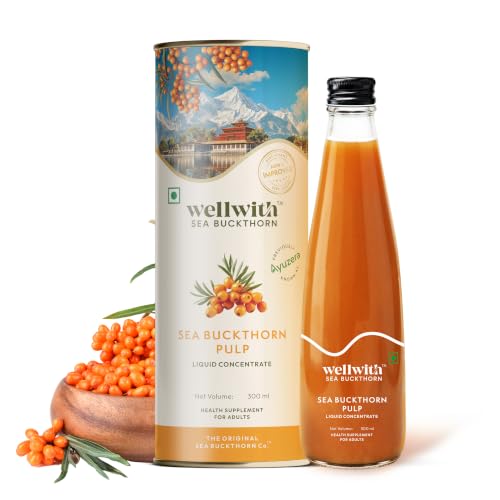
If purity is what you are actually buying, the relevant question is not the word on the front of the bottle but how much water is inside it. This is sold as an undiluted cold-pressed pulp concentrate, meaning it has not been pre-diluted or sweetened before it reaches you, and it is designed to be mixed with water at the point of drinking instead.
That is a more meaningful purity claim than most in this category, and it is backed by a verified review base larger than every other sea buckthorn product in India combined. The berries are described as wild-grown and handpicked in the Nubra Valley in Ladakh. What you should expect is a thick, intensely sour orange pulp that separates on standing, which is what an unhomogenised whole-berry press looks like. If it were clear, thin and pleasant, that would be the warning sign rather than the selling point.
| Specification | Details |
|---|---|
| Format | Undiluted pulp concentrate |
| Bottle size | 300 ml |
| Processing | Cold-pressed, no added water |
| Harvest | Wild-grown, handpicked |
| Source | Nubra Valley, Ladakh |
| Added sugar | None declared |
Pros
| Cons
|
4. My Pahadi Dukan Himalayan Sea Buckthorn Pulp 300ml — Best Wild-Harvest Provenance

This brand exists to sell Himalayan produce rather than supplements, and its sea buckthorn is described as handpicked from high-altitude Ladakh valleys where the plant grows wild. In a category where the word Himalayan is used loosely enough to span several countries and several quality levels, a brand whose entire catalogue is built on hill produce gives that claim more weight.
The product is a thick unhomogenised pulp that separates naturally in the bottle and needs shaking, which is exactly what minimally processed whole-berry juice does. The recurring criticism across its large review base is batch variation in colour and thickness. That is worth reframing: an industrially standardised product looks identical every time precisely because it has been processed to, whereas genuinely wild fruit varies with the season and the harvest. For a purity-focused buyer, variation is closer to evidence than to a defect.
| Specification | Details |
|---|---|
| Harvest | Wild, high-altitude Ladakh valleys |
| Format | Thick unhomogenised pulp |
| Bottle size | 300 ml |
| Processing | Minimal, separates naturally |
| Brand focus | Himalayan produce specialist |
| Variants | Standard and vitamin C enriched |
Pros
| Cons
|
5. The Wellness Shop Himalayan Sea Buckthorn Juice 500ml — Best Cold-Pressed Value

Cold pressing matters more in this category than in most juice categories, because the components that make sea buckthorn worth drinking, the carotenoids and the berry oils, are exactly the ones that degrade under heat. A brand that leads with cold pressing rather than with vague purity language is at least talking about the variable that changes what is in the bottle.
This 500 ml option sits in the useful middle of the market: large enough for a real routine, clearly presented, and without the premium the specialist pulp brands command. The limitation is evidence. The review base is the smallest among the credible options in this guide, and the brand is too new to judge on batch consistency over time. Treat it as a reasonable value choice to watch rather than the safest pick available today, and prefer the established names if certainty matters more than price.
| Specification | Details |
|---|---|
| Processing | Cold-pressed |
| Format | Ready-to-dilute juice |
| Bottle size | 500 ml |
| Source | Himalayan berries |
| Positioning | Middle market value |
| Brand age | Newer entrant |
Pros
| Cons
|
6. Kapiva Sea Buckthorn Juice 500ml — Clearest Free-From Declarations

For a buyer whose priority is what is not in the bottle, this is the least ambiguous option in the category. Kapiva states explicitly that the juice contains no added sugar, no colours and no artificial flavours, and it does so as a mainstream brand whose labelling is held to a consistent standard across a large product range rather than varying from listing to listing.
The juice is sourced from high-altitude Ladakh and marketed on omega 7. It is lighter than the thick specialist pulps, and buyers who have tried those sometimes read the difference as dilution, which is a fair thing to weigh if maximum concentration is your goal. What you get in exchange is a reachable company, retail distribution, and disclosure you can actually verify on the label. In a category where most purity claims cannot be checked at all, that trade is worth considering.
| Specification | Details |
|---|---|
| Free from | Added sugar, colours, artificial flavours |
| Format | Ready-to-dilute juice |
| Bottle size | 500 ml |
| Source | High-altitude Ladakh |
| Brand type | Mainstream wellness |
| Highlighted nutrient | Omega 7 |
Pros
| Cons
|
Storing a Preservative-Free Juice
A shorter ingredient list means a shorter window, so storage stops being optional. Refrigerate immediately after opening and keep the cap tight. Finish the bottle within the period the label states rather than assuming it will keep for months because it is acidic.
Keep it away from light and heat. The carotenoids and oils that make sea buckthorn worth buying are exactly what sunlight on a kitchen shelf destroys, so a bottle stored properly is measurably better than the same bottle stored badly.
Shake before each use, because separation is normal in a minimally processed product. Use a clean spoon or pour directly rather than dipping anything used into the bottle, since introducing contamination is the main way a preservative-free juice spoils early.
Know the spoilage signs: a fizzy or yeasty smell, a bulging bottle, visible mould, or a taste sharp in an unfamiliar way. Discard rather than risk it. And inspect the seal on delivery, because transit damage is a recurring complaint across this category.
Frequently Asked Questions (2026)
Which is the best organic sea buckthorn juice in India?
Nutriorg is the most defensible choice because it comes from a brand with a genuine certified organic range rather than a listing that simply uses the word. Nutrabud Organics holds the better rating among large bottles and describes its fruit as wild-harvested, and the Ayuzera concentrate is the purest in the sense that matters most, being undiluted.
Is wild-harvested better than certified organic?
They are different claims rather than two grades of one thing. Wild sea buckthorn from Ladakh usually grows without agricultural inputs, but nobody audits that. Certified organic is verified but harder to obtain for wild harvests. Neither tells you whether the juice was diluted afterwards, which matters more.
Does organic sea buckthorn juice have more nutrients?
Not necessarily. Organic describes how the crop was grown, not how concentrated the juice is. An uncertified undiluted pulp will deliver more sea buckthorn per glass than a certified juice that has been diluted with water and apple juice concentrate.
Are preservatives in sea buckthorn juice harmful?
The additives used in Indian fruit juices, typically sodium benzoate or potassium sorbate, are permitted at small quantities and the evidence for harm at those levels is not strong. Added sugar is a more meaningful thing to avoid on these labels than a preservative.
How can I tell if the juice is pure?
No consumer test proves it. The observable signals are a deep opaque orange colour, a thick texture that coats the glass, natural separation on standing, an aggressively sour and slightly resinous taste, and an ingredient list showing sea buckthorn alone or with water only.
Why is real sea buckthorn juice so sour?
Because the fruit is genuinely very high in organic acids as well as vitamin C. Sourness is characteristic of the berry rather than a sign of a poor product, and a mild or sweet version usually means dilution or added sweetener.
What does cold-pressed mean and does it matter?
It means the juice was extracted and packed without a heat step. It matters here more than in most juices because sea buckthorn carotenoids and berry oils degrade with heat, so cold pressing retains more of what makes the fruit distinctive.
Does preservative-free juice spoil quickly?
It has a shorter window after opening than a preserved product and depends on refrigeration. Follow the after-opening period on the label, keep the cap tight, avoid contaminating the bottle, and discard it if the smell or taste changes.
Is Jaivik Bharat or India Organic the mark to look for?
Those are the Indian organic marks, and seeing a certification mark with a named certifier is the difference between a verified claim and a printed word. International certifications also appear on exporter brands and carry the same kind of audit behind them.
Should I pay more for an organic label?
Only if the certification is real and the product is otherwise equal. Given the choice between a certified but diluted juice and an uncertified undiluted concentrate, the undiluted product usually gives you more actual sea buckthorn for your money.
Related Guides
Best Sea Buckthorn Juice in India · Best Sea Buckthorn Juice Brand in India · Sea Buckthorn Juice Benefits · Sea Buckthorn Juice Side Effects
Conclusion
In this category, purity is decided by dilution rather than by the words on the front label. A certified organic juice that has been watered down and sweetened with apple juice concentrate delivers less sea buckthorn than an uncertified undiluted pulp, and both bottles can carry entirely truthful claims.
So read the ingredient list before the certification mark. Look for sea buckthorn alone or with water only, a stated pulp percentage if any brand is honest enough to print one, a named origin such as Ladakh or the Nubra Valley, and cold pressing rather than heat treatment. Then judge the bottle when it arrives: deep opaque orange, thick, separating on standing, and unpleasantly sour is what the real thing looks and tastes like.
Nutriorg is the pick if certification is what you want, Nutrabud Organics the best rated large wild-harvested bottle, Ayuzera the purest in the sense that counts because it is undiluted, and My Pahadi Dukan the strongest on Ladakh provenance. Whichever you choose, refrigerate it after opening and finish it in the window the label gives you.