


Last Updated: September 2026
The best toothpaste for sensitive teeth in India is not decided by brand, it is decided by chemistry, and there are four different chemistries sold here under the single word sensitivity. Two of them physically plug the microscopic tubules in exposed dentine so the trigger never reaches the nerve. One calms the nerve itself without closing anything. One rebuilds mineral on the tooth surface. They feel different, they work on different timelines, and they suit different mouths.
We read the Indian ingredient panel of every product on this page, and that turned up something no other guide seems to mention. Several of the most effective sensitivity pastes sold in India either carry less fluoride than a standard adult toothpaste or carry none at all. Sensodyne Repair and Protect lists sodium fluoride at up to 927 ppm, below the usual 1000 to 1500 ppm range. The Indian pharma alternative Vantej lists calcium sodium phosphosilicate as its active with no fluoride in its ingredient list.
That is not a reason to avoid them. It is a reason to know what you are buying, because a person who is both sensitivity-prone and cavity-prone can quietly trade one problem for another by switching tubes completely. Every entry below carries a plain statement of its fluoride position so you can make that call with the information in front of you.
One more thing that matters before you read the list. Dentine sensitivity is a short, sharp zing that stops almost immediately when the cold or sweet trigger is removed. Pain that lingers for thirty seconds or more, pain when you bite down, pain that wakes you at night, or pain triggered by heat is a different problem entirely and no toothpaste on this page addresses it. The guide section explains exactly where that line sits.
Quick Comparison
| Product | Best For | Rating | Link |
|---|---|---|---|
| Sensodyne Repair and Protect | Best overall: NovaMin tubule occlusion | 4.4 (16,500) | Check Price |
| Sensodyne Rapid Relief | Fastest onset of relief | 4.4 (10,100) | Check Price |
| Colgate Sensitive Pro-Relief | Occlusion that keeps full fluoride | 4.3 (2,700) | Check Price |
| Vantej Sensitivity Protection | Indian pharma alternative with the same active | 4.4 (2,800) | Check Price |
| Sensodyne Fresh Gel Daily Sensitivity Relief | Daily use with a milder flavour | 4.4 (5,600) | Check Price |
| Colgate Sensitive Everyday Protection | Budget entry point | 4.2 (3,000) | Check Price |
| Dente91 Enamel Pro | The nano-hydroxyapatite route | 4.1 (3,800) | Check Price |
| Vantej Forte | Newer stronger variant, small sample | 4.5 (239) | Check Price |
Table of Contents
Quick Comparison
1. Sensodyne Repair and Protect
2. Sensodyne Rapid Relief
3. Colgate Sensitive Pro-Relief
4. Vantej Sensitivity Protection
5. Sensodyne Fresh Gel Daily Sensitivity Relief
6. Colgate Sensitive Everyday Protection
7. Dente91 Enamel Pro
8. Vantej Forte
Buying Guide
FAQs
Related Guides
Best Toothpaste for Sensitive Teeth in India: Reviews
1. Sensodyne Repair and Protect
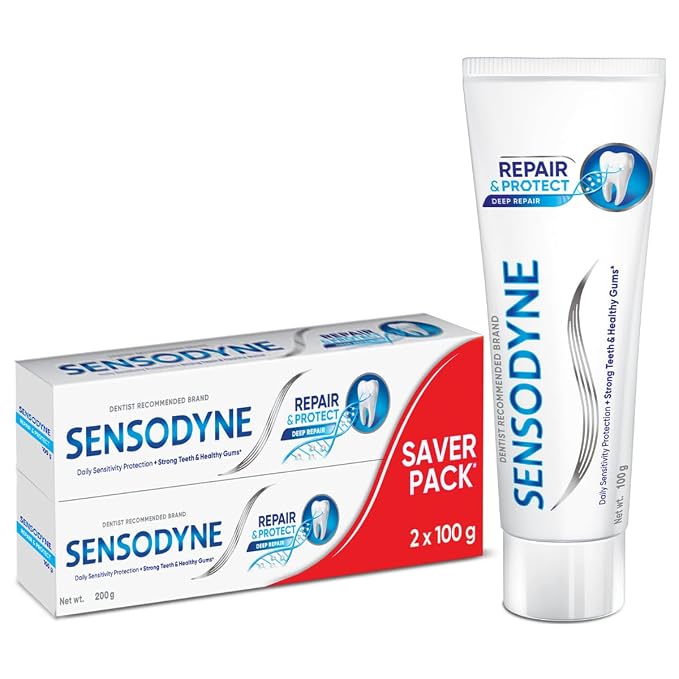

This is the strongest over-the-counter answer to dentine sensitivity available in India, and the reason is the active rather than the brand. The Indian formulation contains five percent NovaMin, a calcium sodium phosphosilicate that reacts with saliva to build a hardened, hydroxyapatite-like layer over exposed dentine and inside the open tubules that carry the pain signal. It works on the cause rather than on the sensation.
The genuinely important detail is that this NovaMin version is sold in India and not in the United States. Foreign reviews and comparison videos are frequently describing a different and weaker formulation under the identical brand name, which means Indian buyers are getting the better product while reading advice written about the lesser one.
The fluoride position needs stating plainly because it is the trade-off. This formula lists sodium fluoride at up to 927 ppm, which sits below the 1000 to 1500 ppm range of a standard adult toothpaste. If sensitivity is your only concern that is irrelevant. If you also get cavities, use this at night so the occluding layer has undisturbed contact time, and use a full-strength fluoride paste in the morning.
| Specification | Details |
|---|---|
| Mechanism | Tubule occlusion via 5 percent NovaMin |
| Fluoride | Sodium fluoride up to 927 ppm, below standard adult strength |
| Time to relief | About two weeks of twice-daily use |
| India advantage | NovaMin version is not sold in the US |
| Best used | At night, with a full-strength paste in the morning |
Pros
| Cons
|
2. Sensodyne Rapid Relief

The complaint that drives people away from sensitivity toothpaste is the waiting. A tube that needs a fortnight before it convinces you is a tube most people abandon on day five, and this variant exists specifically to close that gap by delivering noticeable relief in days rather than weeks.
In practice the sensible way to use it is as a starter rather than a permanent choice. Begin with this to get the sharp episodes under control quickly, then move to the NovaMin formulation for the longer-term structural benefit once the acute discomfort has settled. Several dentists suggest exactly this sequence and it costs no more than committing to one tube from the start.
As with everything in this category, check the pack for its fluoride content rather than assuming it matches a regular paste, since sensitivity formulations across all brands vary on this point and the variation is rarely advertised on the front of the box.
| Specification | Details |
|---|---|
| Positioning | Rapid onset rather than long-term rebuild |
| Time to relief | Days rather than weeks |
| Best used as | A starter tube before switching to a NovaMin formula |
| Review volume | Large |
| Check on pack | Fluoride content, which varies across sensitivity pastes |
Pros
| Cons
|
3. Colgate Sensitive Pro-Relief

This is the answer for the person who wants tubule occlusion without giving up cavity protection, and reading the Indian ingredient panel shows exactly why. It lists arginine bicarbonate together with calcium carbonate, the Pro-Argin system that forms a calcium-rich plug inside the dentine tubules, alongside sodium monofluorophosphate as the fluoride source. You get occlusion and fluoride in the same tube, which several rivals on this page do not offer.
There is a technique instruction printed on this pack that almost nobody follows and that materially changes the result. The directions say to apply the paste directly to the sensitive tooth with a fingertip and massage gently for a minute, in addition to normal brushing. That targeted minute delivers far more active to the specific area than a general brush ever will, and it is free.
For a household where one person has sensitivity and a history of cavities, this is usually the most sensible single purchase on the page, because it removes the need to run two tubes in parallel.
| Specification | Details |
|---|---|
| Mechanism | Pro-Argin occlusion using arginine and calcium carbonate |
| Fluoride | Sodium monofluorophosphate, present |
| Key technique | Rub onto the sensitive tooth with a fingertip for one minute |
| Best for | Sensitivity plus a history of cavities |
| Advantage | Occlusion and fluoride in one tube |
Pros
| Cons
|
4. Vantej Sensitivity Protection


Vantej comes from an established Indian pharmaceutical company rather than a consumer goods group, and its ingredient panel makes a claim worth taking seriously: calcium sodium phosphosilicate is listed as the active ingredient. That is chemically the same family of tubule-occluding material that makes the leading imported sensitivity paste work, offered by a domestic manufacturer.
The fluoride position is the thing to weigh. The ingredient list published on the Indian listing shows the phosphosilicate active alongside glycerin, PEG, silica, sodium lauryl sulphate, titanium dioxide, carbomer and a sweetener, with no fluoride compound among them. So this is an occluding paste rather than a protective one, and anyone using it should pair it with a fluoride paste rather than replace their fluoride entirely.
Used that way it is a genuinely strong option, particularly for buyers who prefer an Indian pharma brand or who find the imported alternative expensive for daily long-term use. Its directions also describe a warm sensation during brushing, which is normal for this chemistry and not a sign of irritation.
| Specification | Details |
|---|---|
| Mechanism | Tubule occlusion via calcium sodium phosphosilicate |
| Fluoride | Not listed in the published ingredient list |
| Manufacturer | Established Indian pharmaceutical company |
| Best used | Paired with a fluoride paste, not as a replacement |
| Note | A warm sensation while brushing is normal for this chemistry |
Pros
| Cons
|
5. Sensodyne Fresh Gel Daily Sensitivity Relief

A sensitivity paste only works if you actually use it twice a day for months, and the most common reason people stop is not price but taste. The clinical sensitivity formulations tend to be flat and medicinal, and a household that dislikes the flavour quietly drifts back to their old mint tube, losing the benefit entirely.
This gel exists to solve that behavioural problem. It carries a daily sensitivity formulation in a fresher, more conventional gel format that feels much closer to an ordinary toothpaste, which makes long-term compliance dramatically easier. For mild to moderate sensitivity in someone who has abandoned a clinical paste before, this is often the practical winner even though a stronger formulation exists.
Treat it as maintenance rather than rescue. If your sensitivity is severe, start with a rapid formula or a NovaMin formula to get it under control, then move here for the long haul where the pleasant experience keeps you consistent.
| Specification | Details |
|---|---|
| Positioning | Daily maintenance rather than acute rescue |
| Format | Gel with a conventional fresh flavour |
| Best for | Mild to moderate sensitivity and long-term compliance |
| Strength | Lower impact than the NovaMin formulation |
| Review volume | Solid |
Pros
| Cons
|
6. Colgate Sensitive Everyday Protection

Not everyone needs to start at the top of this category. If your sensitivity is occasional, triggered only by very cold water or ice cream and gone within a second, a mainstream sensitivity paste at a mainstream price is a reasonable first attempt before spending on a clinical formulation.
What you should understand is what the cheaper route generally buys. Nerve-calming actives such as potassium nitrate reduce the pain signal without closing the tubules, which means relief arrives but the underlying exposure remains and the sensitivity tends to return fairly quickly once you stop using the paste. Occluding formulations physically plug the tubules, so their benefit persists somewhat longer after you switch away.
For occasional, mild sensitivity that is an acceptable trade. For daily sensitivity that affects what you are willing to eat and drink, spend the extra on an occluding formulation, because you will otherwise be managing a symptom indefinitely rather than reducing the cause.
| Specification | Details |
|---|---|
| Positioning | Mainstream entry-level sensitivity paste |
| Typical mechanism | Nerve calming rather than tubule occlusion |
| Best for | Occasional mild sensitivity |
| Relief persistence | Tends to fade once use stops |
| Cost | Lowest in this category |
Pros
| Cons
|
7. Dente91 Enamel Pro

This represents the fourth chemistry in the Indian sensitivity market and the one growing fastest. The listing describes enamel remineralisation using nano hydroxyapatite, a synthetic form of the mineral teeth are actually made of, which deposits on the surface and into surface defects rather than relying on fluoride to drive remineralisation.
It is the natural destination for buyers who want to avoid fluoride for personal reasons but still want a scientific rather than herbal approach, and it is a legitimate option rather than a gimmick. The honest caveat is that hydroxyapatite has a shorter and thinner body of evidence for cavity prevention than fluoride does, which has decades of replicated trials behind it. For sensitivity specifically the mechanism is plausible and users report good results.
If you are choosing this, choose it knowingly as a fluoride alternative rather than assuming it is a fluoride paste with a bonus. Read the pack, because formulations in this segment change often and some variants do include fluoride while others deliberately do not.
| Specification | Details |
|---|---|
| Mechanism | Remineralisation via nano hydroxyapatite |
| Positioning | Scientific alternative to fluoride |
| Evidence base | Thinner than fluoride, but plausible and growing |
| Best for | Buyers avoiding fluoride by choice |
| Check on pack | Fluoride status varies by variant |
Pros
| Cons
|
8. Vantej Forte


This is the stronger variant of the Indian pharma sensitivity line, positioned around enhanced tooth strength and cavity protection alongside the sensitivity action, and it currently carries the highest star average on this page. That figure comes with an important qualification: the review sample is small because the product is recent.
A few hundred ratings is a promising early signal, not proof. In a category where the established products carry ten to sixteen thousand ratings accumulated across years of repeat purchase, a new entrant with a high average has simply not been tested across enough different mouths, water conditions and brushing habits for that number to mean what it appears to mean.
We have included it because the underlying chemistry from this manufacturer is sound and the variant is a logical upgrade, and because a buyer who has already had good results with the standard version has a reasonable basis for trying it. We would not recommend it as a first purchase over the products above, purely on evidence grounds.
| Specification | Details |
|---|---|
| Positioning | Stronger variant of the Indian pharma sensitivity line |
| Star average | Highest on this page |
| Review volume | Small, product is recent |
| Evidence status | Promising early signal, not established |
| Best for | Existing users of the standard version |
Pros
| Cons
|
How to Choose a Sensitivity Toothpaste in India
Know which of the four chemistries you are buying
Tubule occlusion physically plugs the microscopic channels in exposed dentine, and in India that comes as NovaMin calcium sodium phosphosilicate, as the Pro-Argin arginine and calcium carbonate system, or as nano hydroxyapatite. Nerve calming, usually potassium nitrate, reduces the pain signal without closing anything. Occlusion treats the cause and its benefit persists longer after you stop. Nerve calming treats the sensation and fades faster. Both are legitimate, but they are not the same purchase.
Audit the fluoride, because this category quietly drops it
This is the finding most guides miss. Sensodyne Repair and Protect lists sodium fluoride at up to 927 ppm, below the 1000 to 1500 ppm standard. Vantej lists calcium sodium phosphosilicate with no fluoride compound in its ingredient list. Colgate Sensitive Pro-Relief does carry sodium monofluorophosphate. If you switch your only toothpaste to a sensitivity formula without checking, you may be solving sensitivity while reducing your decay protection.
The two-tube routine solves the trade-off completely
If you are both sensitivity-prone and cavity-prone, do not choose. Use the sensitivity paste at night, when the occluding layer gets the longest undisturbed contact time while saliva flow is lowest, and a full-strength fluoride paste in the morning. This costs the same as running one premium tube and gives you both benefits instead of trading one for the other.
Give it two full weeks before judging, and do not rinse it away
Occluding pastes build their effect over roughly a fortnight of twice-daily use. Most people who conclude sensitivity toothpaste does not work stopped on day four or five. Equally important, spit out the excess and do not rinse your mouth with water immediately afterwards, because rinsing washes off the very layer you are trying to build.
The fingertip technique is printed on the pack and almost nobody uses it
The directions on Colgate Sensitive Pro-Relief tell you to apply the paste directly to the sensitive tooth with a fingertip and massage for a minute, in addition to brushing. This delivers far more active to the specific spot than distributing it around the whole mouth. It works with any occluding paste, it costs nothing, and it is the single highest-return habit in this guide.
Know where sensitivity ends and a dental problem begins
Genuine dentine sensitivity is a short sharp zing that stops within a second or two of the trigger going away. Pain that lingers thirty seconds or more, pain when biting down, pain that wakes you at night, pain triggered by heat rather than cold, or pain in a single specific tooth that is getting worse are all signals of something else, such as decay reaching the nerve, a cracked tooth or an infection. No toothpaste on this page treats any of those, and delaying on a new tube can turn a filling into a root canal.
Find the cause, because the paste only manages the effect
Dentine gets exposed for reasons, and the common ones are brushing too hard with a hard brush, gum recession, grinding at night, and acid erosion from citrus, aerated drinks and reflux. If you keep the cause running, you are asking a toothpaste to repair faster than you are damaging. Switch to a soft brush, hold it like a pen rather than gripping it, and stop scrubbing sideways.
Never brush straight after something acidic
Enamel is temporarily softened for a while after citrus, aerated drinks, vinegar or reflux, and brushing during that window removes more mineral than it protects. Rinse with plain water instead and wait at least half an hour. People with sensitivity often brush immediately after these triggers precisely because their mouth feels unpleasant, which makes the underlying problem worse.
Whitening pastes and sensitivity do not mix well
A heavy polishing paste on already exposed dentine usually increases discomfort. If you want both, use a whitening formulation from a sensitivity brand, or alternate the two tubes so the sensitivity active still gets its overnight contact. Do not brush harder in the belief that pressure improves either result, because pressure is a leading cause of the recession that started the sensitivity.
Hard water, spicy food and traditional remedies
Indian households often blame water quality or spice for sensitivity, and neither is the usual cause. The usual causes are mechanical and acidic. Also avoid the traditional habit of rubbing salt or ash on the teeth, which is abrasive enough to accelerate exactly the enamel and gum-line loss that creates sensitivity in the first place.
Frequently Asked Questions
Which is the best toothpaste for sensitive teeth in India?
For most people, Sensodyne Repair and Protect, because the Indian version contains five percent NovaMin and physically occludes the tubules rather than only calming the nerve. If you also get cavities, Colgate Sensitive Pro-Relief is the better single choice because it combines occlusion with a fluoride compound in the same tube.
How long does sensitivity toothpaste take to work?
Occluding formulations generally need about two weeks of twice-daily use, with the effect continuing to build after that. Rapid-relief variants aim for days rather than weeks. If nothing has improved after three to four weeks of correct use, the problem is probably not dentine sensitivity and needs a dentist.
Does Sensodyne contain fluoride?
The Indian Repair and Protect formulation lists sodium fluoride at up to 927 ppm, which is below the 1000 to 1500 ppm of a standard adult toothpaste. It does contain fluoride, just less of it, which is why pairing it with a full-strength paste in the morning is sensible for anyone prone to cavities.
Is Vantej as good as Sensodyne?
It uses calcium sodium phosphosilicate, the same occluding chemistry family, and comes from an established Indian pharmaceutical company at a lower cost per gram. The difference is that its published ingredient list shows no fluoride, so it should be paired with a fluoride paste rather than used as your only toothpaste.
Can sensitivity toothpaste be used permanently?
Yes, and for many people it should be, because the causes of exposed dentine such as gum recession do not reverse. The only thing to manage is fluoride exposure, which is why the two-tube routine of a sensitivity paste at night and a full-strength fluoride paste in the morning works so well long term.
Why does my sensitivity come back when I stop the toothpaste?
Because the underlying exposure has not gone away. Nerve-calming actives such as potassium nitrate stop working almost as soon as you stop using them. Occluding actives leave a physical layer that persists somewhat longer but also wears away. The paste manages the condition rather than curing it.
Is nano hydroxyapatite better than fluoride?
For sensitivity, the mechanism is plausible and users report good results. For preventing cavities, fluoride has decades of replicated trial evidence while hydroxyapatite has a thinner and newer body of research. If you are avoiding fluoride by choice, hydroxyapatite is the most scientifically grounded alternative available. If you are not, fluoride remains the better documented option.
Can I use whitening and sensitivity toothpaste together?
Not simultaneously in one brushing. Either use a whitening formulation made by a sensitivity brand, or alternate them so the sensitivity active gets its overnight contact time. Using a heavy polishing paste on exposed dentine usually makes the discomfort worse.
Why do my teeth hurt with cold water only in winter?
Cold air and colder tap water in winter lower the trigger threshold, so existing exposed dentine that was tolerable in summer becomes painful. It usually indicates the exposure was already there rather than a new problem, and a sensitivity paste started before winter each year manages it well.
Should I use a soft or hard toothbrush for sensitive teeth?
Soft, always, and with light pressure. Hard bristles combined with sideways scrubbing are among the most common causes of the gum recession and enamel wear that create sensitivity. Hold the brush like a pen rather than gripping it in a fist, which naturally reduces the force you apply.
When is sensitivity a sign of something serious?
When the pain lingers for thirty seconds or more after the trigger, when it hurts to bite down, when heat rather than cold sets it off, when it wakes you at night, or when it is localised to one tooth and worsening. Those patterns suggest decay reaching the nerve, a cracked tooth or infection, and they need a dentist rather than a toothpaste.
Does salt or ash help with tooth sensitivity?
No, and both are likely to make it worse. They are abrasive enough to accelerate the enamel and gum-line wear that exposes dentine in the first place. Traditional cleaning powders of this kind are one of the more common avoidable causes of sensitivity in Indian mouths.
Related Guides
Best Toothpaste in India | Top 5 Best Toothpaste in India | Best Whitening Toothpaste in India | Toothpaste Brands of India | Best Herbal Toothpaste in India | Best Toothpaste for Gums and Bad Breath | Best Toothpaste for Kids in India | Best Electric Toothbrush in India
Conclusion
The best toothpaste for sensitive teeth in India comes down to two questions, and neither of them is about brand. First, do you want occlusion or nerve calming? Occlusion plugs the tubules and treats the cause, and in India it is available as NovaMin in Sensodyne Repair and Protect, as calcium sodium phosphosilicate in Vantej, as the Pro-Argin system in Colgate Sensitive Pro-Relief, and as nano hydroxyapatite in the newer Indian brands. Nerve calming is cheaper, faster to feel and quicker to fade.
Second, what happens to your fluoride? This is the question no other guide seems to ask, and the ingredient panels answer it clearly. Sensodyne Repair and Protect carries fluoride at up to 927 ppm, below standard adult strength. Vantej lists no fluoride at all. Colgate Sensitive Pro-Relief keeps a fluoride compound alongside its occluding system. Switching your only toothpaste without checking can solve one problem while opening another.
The practical answer for most people is the two-tube routine: a sensitivity paste at night when contact time is longest, a full-strength fluoride paste in the morning, a soft brush held lightly, no rinsing after brushing, and a fingertip minute of paste massaged onto the worst tooth. And if the pain lingers, wakes you, or responds to heat, close this page and book a dentist, because that is no longer sensitivity.
Affiliate Disclosure: As an Amazon Associate, we earn from qualifying purchases. This does not affect the price you pay.