


Last Updated: August 2026
An air purifier for car tackles a problem most drivers ignore — the air inside your cabin can be more polluted than outside, thanks to traffic fumes, dust and PM2.5 seeping in during commutes. A compact car purifier cuts these pollutants, plus smoke and odours, keeping the air you breathe on the road cleaner and fresher, which matters especially in India high-pollution cities.
We compared the best car air purifiers sold in India, judging each on filtration or ionizer performance, coverage for a car cabin, power source and build. Below are our top seven picks so you can breathe cleaner air on every drive.
Quick Comparison
| Product | Best For | Type | Rating | Buy |
|---|---|---|---|---|
| Reffair AX50 Car Air Purifier (Plasma Ionizer) | Best Overall | HEPA + Plasma Ionizer | 4.4★ (322) | Check Price |
| GOODAIR Royal Non-Electric Car Purifier | Most Popular | Non-Electric | 4.0★ (3.1K) | Check Price |
| Honeywell Move Pure3 Car Purifier (HEPA) | Trusted HEPA | HEPA Filter | 4.0★ (146) | Check Price |
| SHARP Car Air Purifier (Plasmacluster) | Plasmacluster Tech | Plasmacluster Ion | 4.1★ (310) | Check Price |
| Philips Car Air Purifier (3601) | Trusted Brand | HEPA Car | 3.9★ (271) | Check Price |
| Nebelr IonDrive 205 Car Purifier (Ionizer) | Ionizer Value | Ionizer | 4.0★ (796) | Check Price |
| Dr. CHARCOAL Car Air Purifier (Non-Electric) | Most Reviewed | Activated Charcoal | 3.8★ (5.6K) | Check Price |
Table of Contents
- 1. Reffair AX50 Car Air Purifier (Plasma Ionizer)
- 2. GOODAIR Royal Non-Electric Car Purifier
- 3. Honeywell Move Pure3 Car Purifier (HEPA)
- 4. SHARP Car Air Purifier (Plasmacluster)
- 5. Philips Car Air Purifier (3601)
- 6. Nebelr IonDrive 205 Car Purifier (Ionizer)
- 7. Dr. CHARCOAL Car Air Purifier (Non-Electric)
- Buying Guide
- Why Your Commute Is the Worst Air You Breathe All Day
- FAQs
- Conclusion
1. Reffair AX50 Car Air Purifier (Plasma Ionizer)


The Reffair AX50 is our top car pick, combining a HEPA filter with a plasma ionizer to tackle dust, PM2.5, smoke and odours together in a compact, cup-holder-friendly design. The ionizer releases negative ions to freshen the cabin air, while the HEPA layer traps fine particles, giving comprehensive purification purpose-built for a car interior.
With a 4.4-star average, it is a well-rated, dependable choice from a brand focused on portable air care. It runs off the car USB or 12V socket, looks smart on the dashboard or in a cup holder, and quietly improves cabin air on every commute. For most drivers wanting effective car purification, the AX50 is the standout.
| Specification | Details |
|---|---|
| Filtration | HEPA + plasma ionizer |
| Captures | Dust, PM2.5, smoke, odours |
| Design | Cup-holder friendly |
| Power | USB / 12V car socket |
| Brand | Reffair |
| Best for | All-round car purification |
| ✔ Pros • HEPA + ionizer combo • Cup-holder design • Handles odours & smoke • High 4.4 rating | ✘ Cons • Small cabin coverage • Filter needs replacing |
2. GOODAIR Royal Non-Electric Car Purifier
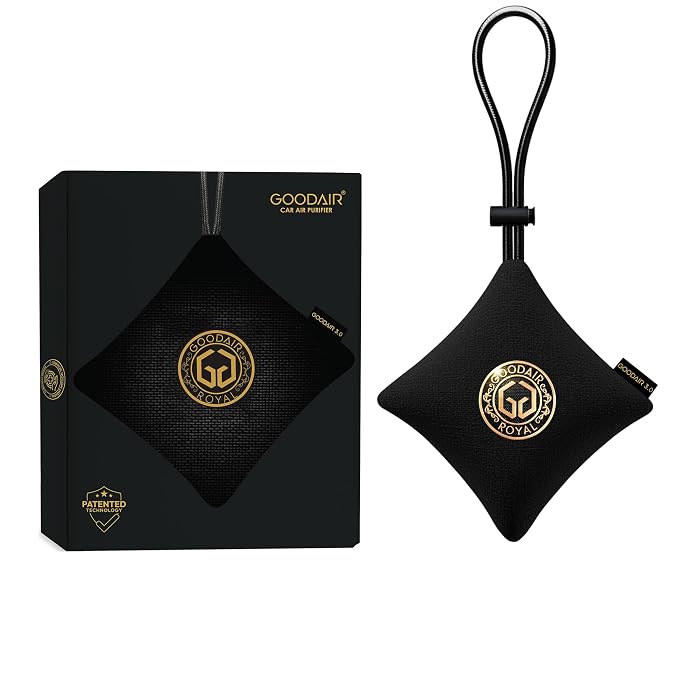

The GOODAIR Royal is the most popular car air freshener-purifier in India, with over 3,100 ratings behind it. This non-electric option uses natural mineral-based purification to absorb odours, smoke and pollutants without needing any power or filters, making it completely maintenance-free — just place it in the car and it works passively.
Its no-power, no-filter design is its biggest appeal: there is nothing to plug in, charge or replace, and it lasts a long time. While it works more subtly than an electric ionizer, its huge popularity reflects genuine satisfaction. For drivers who want a fuss-free, always-on cabin freshener, the GOODAIR Royal is a proven pick.
| Specification | Details |
|---|---|
| Type | Non-electric mineral |
| Power | None needed |
| Captures | Odours, smoke, pollutants |
| Maintenance | No filters |
| Brand | GOODAIR |
| Best for | Fuss-free passive use |
| ✔ Pros • No power or filters needed • 3,100+ ratings • Long-lasting • Maintenance-free | ✘ Cons • Subtler than electric units • Not a HEPA purifier |
3. Honeywell Move Pure3 Car Purifier (HEPA)

The Honeywell Move Pure3 brings the trusted air-care brands HEPA filtration to the car, capturing dust, allergens and PM2.5 in a compact design that fits a cup holder or console. Honeywell is a recognised name in air quality, and the Move Pure3 offers dependable particle filtration with a clean, functional look for the cabin.
With a 4.0-star average, it is a solid choice for drivers who want genuine HEPA filtration from a familiar brand rather than just an ionizer. It runs off the car power socket and quietly cleans cabin air on your commute. For buyers who prioritise a trusted brand and real HEPA filtration in the car, the Move Pure3 is a dependable option.
| Specification | Details |
|---|---|
| Filtration | HEPA filter |
| Captures | Dust, allergens, PM2.5 |
| Design | Compact car-friendly |
| Power | Car socket |
| Brand | Honeywell |
| Best for | Trusted HEPA in car |
| ✔ Pros • Trusted Honeywell brand • Genuine HEPA filtration • Compact car design • Reliable performance | ✘ Cons • Smaller review base • Filter replacements needed |
4. SHARP Car Air Purifier (Plasmacluster)

The SHARP car purifier uses the brands patented Plasmacluster ion technology, which releases positive and negative ions to break down airborne pollutants, odours and some bacteria in the cabin. SHARP is well known for this ionizing technology, and the compact car unit brings it to your commute in a neat, dashboard-friendly form.
With a 4.1-star average, it is a well-regarded ionizing option for drivers who want SHARPs proven Plasmacluster approach rather than a filter-based purifier. It freshens the cabin and helps neutralise odours effectively. For buyers who trust SHARPs ion technology, this car purifier is a strong, distinctive choice. Buyers consistently praise how noticeably fresher the air feels within the first day of use.
| Specification | Details |
|---|---|
| Tech | Plasmacluster ions |
| Captures | Pollutants, odours, bacteria |
| Design | Compact car unit |
| Power | Car socket |
| Brand | SHARP |
| Best for | Ion technology fans |
| ✔ Pros • Patented Plasmacluster tech • Neutralises odours • Trusted SHARP brand • Compact design | ✘ Cons • Ionizer, not HEPA • Average review count |
5. Philips Car Air Purifier (3601)


The Philips Car Air Purifier 3601 brings the globally respected air-care brands filtration to the cabin, targeting dust, PM2.5 and allergens with a compact, car-friendly design. Philips is a trusted name in air purification, and this unit offers dependable filtration with the reassurance of an established brand and widely available parts.
With a 3.9-star average, it is a sensible choice for drivers who want Philips reliability in the car. It fits neatly in a cup holder or on the console and runs off car power to quietly clean cabin air. For buyers who value a trusted global brand for their car purifier, the Philips 3601 is a dependable pick.
| Specification | Details |
|---|---|
| Filtration | HEPA-based |
| Captures | Dust, PM2.5, allergens |
| Design | Cup-holder / console |
| Power | Car socket |
| Brand | Philips |
| Best for | Trusted brand buyers |
| ✔ Pros • Trusted Philips brand • Compact car design • Dependable filtration • Widely available | ✘ Cons • Lower 3.9 rating • Filter replacements needed |
6. Nebelr IonDrive 205 Car Purifier (Ionizer)

The Nebelr IonDrive 205 is a popular ionizing car purifier with over 790 ratings, releasing negative ions to freshen the cabin and reduce airborne dust, smoke and odours. Its compact plug-in design fits the car socket and works continuously while you drive, offering a simple, effective way to improve cabin air quality.
With a 4.0-star average, it is a well-liked value option for drivers who prefer an ionizer approach without filters to replace. The steady negative-ion output keeps the cabin feeling fresher, particularly helpful in traffic. For buyers who want an affordable, maintenance-light ionizing car purifier, the Nebelr IonDrive is a strong pick. It runs efficiently, keeping power consumption low even when left on for long periods.
| Specification | Details |
|---|---|
| Type | Negative-ion ionizer |
| Captures | Dust, smoke, odours |
| Design | Compact plug-in |
| Power | Car socket |
| Brand | Nebelr |
| Best for | Value ionizing |
| ✔ Pros • 790+ ratings • No filters to replace • Freshens cabin air • Affordable | ✘ Cons • Ionizer, not HEPA • Subtle effect |
7. Dr. CHARCOAL Car Air Purifier (Non-Electric)

The Dr. CHARCOAL car purifier is one of the most-reviewed options in India, with over 5,600 ratings for its non-electric activated-charcoal bag design. It absorbs odours, moisture and some pollutants naturally, lasts around a year, and needs no power or filters — you simply place it in the car and recharge it periodically in sunlight.
Its huge review base reflects genuine popularity as a fuss-free, always-on odour absorber. While it is a passive charcoal solution rather than an active HEPA purifier, it is highly effective at keeping the cabin smelling fresh with zero running cost. For drivers who want a maintenance-free, long-lasting odour solution, Dr. CHARCOAL is a proven favourite.
| Specification | Details |
|---|---|
| Type | Activated charcoal (non-electric) |
| Power | None needed |
| Captures | Odours, moisture, pollutants |
| Life | ~1 year (sun-recharge) |
| Brand | Dr. CHARCOAL |
| Best for | Passive odour control |
| ✔ Pros • 5,600+ ratings • No power or filters • Lasts ~1 year • Zero running cost | ✘ Cons • Charcoal bag, not HEPA • Passive odour focus only |
How to Choose an Air Purifier for Car
Decide: HEPA filter or ionizer
Filter-based car purifiers (Reffair, Honeywell, Philips) physically trap dust and PM2.5, while ionizers (SHARP, Nebelr) release ions to freshen air and cut odours. For particle removal, choose HEPA; for fresh-smelling cabin air, an ionizer or charcoal works well.
Match it to a car cabin, not a room
Car purifiers are compact and designed for the small cabin volume. You do not need high room-sized coverage — a unit rated for a car interior is enough. Do not expect it to match a home purifier.
Check the power source and fit
Most car purifiers run off the 12V socket or a USB port. Confirm it fits your cup holder, dashboard or console neatly, and that the cable reaches a power point without cluttering the cabin.
Consider non-electric options for zero maintenance
Non-electric charcoal or mineral purifiers (Dr. CHARCOAL, GOODAIR) need no power or filter changes and last a long time. They focus on odours rather than fine particles, but are the most fuss-free option.
Factor in filter replacement for HEPA units
Filter-based car purifiers need periodic filter replacement to stay effective. Check the filter cost and availability so running costs stay reasonable over time, especially with heavy daily commuting.
Understand that a car cabin is a different problem from a room
A room purifier works on a sealed volume that reloads slowly. A car cabin is tiny but exchanges air constantly through the ventilation system while you sit directly behind exhaust pipes in traffic. That means a car unit is fighting continuous re-entry rather than cleaning a fixed volume once, which is why room purifiers cannot simply be adapted to a car and why cabin units are rated differently.
Recirculation mode matters more than the purifier itself
If your ventilation is set to draw outside air while you sit in traffic, you are pumping the exhaust of the vehicle ahead directly into the cabin faster than any small purifier can clean it. Switching to recirculation during heavy traffic is free, takes one button press, and does more for cabin air than most purifiers do. Use the purifier to clean the recirculated air, not to fight a constant inflow.
Replace the cabin air filter before buying anything
Almost every car has a cabin air filter behind the glovebox that most owners never change, and a clogged one restricts airflow and stops filtering. Replacing it is inexpensive and often makes a bigger difference than adding a purifier. Some cars accept a HEPA-grade cabin filter as a direct replacement, which is the single most cost-effective upgrade available for car air.
Check what the unit actually filters, not just that it glows
The car accessory market is full of small devices that ionise or emit ozone without any physical filter, because that is cheaper to build than a HEPA stage. Ionisers do not remove particulate the way a filter does, and ozone in an enclosed cabin is undesirable. Look for a stated HEPA filter and check that replacement cartridges are available before buying.
Mount it where the airflow reaches you, and secure it properly
A purifier rolling around a footwell or perched loosely on a dashboard is both ineffective and a hazard under braking. Use the supplied mount or the cup holder, position it so the outlet is in the cabin rather than pointed at a seat back, and route the 12V cable so it cannot foul the pedals. This is a safety point as much as a performance one.
Be realistic about what a cabin unit can achieve
A small purifier in a constantly exchanging cabin reduces exposure rather than eliminating it. Owners who report the clearest benefit are those who combine it with recirculation, a fresh cabin filter and closed windows in heavy traffic. Treating the device as a licence to drive with the windows down through a congested junction defeats the purpose entirely.
Why Your Commute Is the Worst Air You Breathe All Day
For a great many urban Indians, the highest particulate exposure of the entire day happens during the commute, and it is the part almost nobody addresses. Understanding why makes it clear what a car purifier can realistically contribute.
Why traffic is the peak exposure window
Sitting in slow traffic places you directly downstream of the exhaust of the vehicle in front, at the height where those emissions are freshest and most concentrated. Measurements taken inside vehicles in congested urban conditions routinely show particulate levels well above ambient readings for the same area. A commute of an hour each way can therefore contribute a disproportionate share of a day total exposure, despite being a small fraction of the hours.
The three defences, in order of effectiveness
First, close the windows and switch the ventilation to recirculation during heavy traffic, which costs nothing and cuts the inflow immediately. Second, replace the cabin air filter on schedule, or fit a HEPA-grade one if your model accepts it, since a clogged filter is filtering nothing. Third, add a cabin purifier to clean the recirculated air. In that order, because the first two are cheaper and more effective than the third.
What a car purifier realistically delivers
It reduces particulate in the cabin over the course of a drive, particularly when the air is being recirculated rather than constantly replaced. It will not produce clean-room air in a vehicle stuck at a congested junction with the windows open, and no device of that size could. Judge it as one layer of a three-part approach rather than as a complete solution on its own.
A note on ionisers and ozone in cars
Many inexpensive car air devices work by ionisation alone, with no physical filter. Ionisers can make particles clump and settle rather than removing them from the vehicle, and they produce trace ozone, which is more of a concern in a small enclosed cabin than in a room. If you have asthma or reactive airways, prefer a genuine HEPA filter unit and avoid ozone-generating devices entirely.
Frequently Asked Questions
Which is the best air purifier for car in India?
The Reffair AX50 is our top pick, combining a HEPA filter with a plasma ionizer for comprehensive cabin purification. The GOODAIR Royal is the most popular non-electric option, and the Honeywell Move Pure3 is the best trusted-brand HEPA choice.
Do car air purifiers actually work?
Yes, within a car cabin. Filter-based units trap dust and PM2.5, while ionizers and charcoal reduce odours and freshen the air. They are effective for the small cabin volume, though they work on a smaller scale than home room purifiers.
Should I get a HEPA or ionizer car purifier?
Choose a HEPA-filter car purifier (like the Reffair or Honeywell) if you want to trap fine dust and PM2.5. Choose an ionizer or charcoal (SHARP, GOODAIR, Dr. CHARCOAL) if your main concern is odours and fresh-smelling cabin air.
How are car air purifiers powered?
Most car air purifiers run off the 12V car socket or a USB port. Non-electric options like charcoal or mineral purifiers need no power at all and work passively, needing only occasional recharging in sunlight.
Do car air purifiers remove smoke and odours?
Yes. Ionizers and activated-charcoal units are particularly good at neutralising smoke and odours, while HEPA-plus-carbon units like the Reffair tackle both particles and smells. Choose a carbon or ionizer model if odour control is your priority.
Related Guides: Best Air Purifier in India | Best HEPA Air Purifier | Air Purifier Under 5000 | Best Smart Air Purifier | Best Air Purifier Brand
Do car air purifiers actually work?
A unit with a genuine HEPA filter does reduce cabin particulate over the course of a drive, particularly when the ventilation is set to recirculate. It cannot keep up with a constant inflow of outside air, so it works best alongside closed windows and recirculation in heavy traffic rather than as a standalone fix.
Is a car air purifier better than just using recirculation mode?
Recirculation is the more important step and it is free, so use it first. It stops the exhaust of the vehicle ahead being drawn into the cabin. A purifier then cleans the air that is being recirculated, which is where it adds value. The two together are far more effective than either alone.
Should I replace my cabin air filter instead of buying a purifier?
Replace it regardless, and ideally before buying anything. Most owners never change the cabin filter behind the glovebox, and a clogged one restricts airflow while filtering very little. Some cars accept a HEPA-grade replacement, which is often the most cost-effective improvement to cabin air available.
Are ioniser car purifiers safe?
Ionisers without a physical filter make particles clump and settle rather than removing them from the vehicle, and they produce trace ozone, which is a greater concern in a small enclosed cabin than in a room. If you have asthma or sensitive airways, choose a unit with a genuine HEPA filter and avoid ozone-generating devices.
Can I use a room air purifier in my car?
No. Room units need mains power and are designed for a sealed volume that reloads slowly, whereas a car cabin exchanges air constantly and runs on a 12V supply. A device made for cabin use, mounted securely and powered from the car socket, is the right tool; a room purifier balanced on a seat is neither safe nor effective.
Conclusion
A car air purifier makes every commute healthier by cutting the dust, PM2.5, smoke and odours that build up in your cabin. The Reffair AX50 is our top pick for its HEPA-plus-ionizer performance, while the GOODAIR Royal is the most popular fuss-free non-electric option and the Honeywell Move Pure3 is the best trusted-brand HEPA choice.
Decide between HEPA filtration and an ionizer or charcoal based on whether particles or odours are your priority, and check the fit and power source. Use the comparison table above to shortlist and pick the best car air purifier for your drives.
Affiliate Disclosure: As an Amazon Associate we earn from qualifying purchases.